Newsletter Subscribe
Enter your email address below and subscribe to our newsletter
AVIATION JOBS GUIDE

Barriers to entry for an A&P mechanic career may keep some on the sidelines. The aviation maintenance field is one of the most stable, essential, and respected technical professions in the world. Yet despite the strong demand for skilled technicians, many aspiring students still wonder about the Barriers to Entry for an A&P Mechanic and whether the path is realistic for them. The truth is that the career is accessible — but not without challenges. Understanding these barriers helps future mechanics prepare, plan, and enter the industry with confidence.
This article breaks down the financial, educational, regulatory, and personal hurdles that shape the Barriers to Entry for an A&P Mechanic, giving you a clear picture of what it takes to earn the certificate and start a long-term aviation career.
Before diving into the specific Barriers to Entry for an A&P Mechanic, it’s important to understand the structure of the certification itself. The FAA issues two ratings:
Most technicians pursue both ratings together, earning the full A&P certificate.
There are three pathways to qualify for the FAA exams:
Each pathway has its own advantages and its own Barriers to Entry for an A&P Mechanic, which we’ll explore in detail.
One of the most significant Barriers to Entry for an A&P Mechanic is the cost of training. FAA Part 147 schools typically cost:
For many students, this is the first major obstacle. While financial aid and GI Bill benefits can help, the upfront cost remains a major factor in whether someone pursues the career.
Because A&P programs are full‑time, students often cannot work enough hours to support themselves. Rent, transportation, and food become part of the Barriers to Entry for an A&P Mechanic, especially in cities where aviation schools are located.
Most employers require mechanics to bring their own tools. A starter set typically costs:
This additional expense adds to the financial Barriers to Entry for an A&P Mechanic, especially for new graduates.
A&P training is academically demanding. Students must learn:
For students who struggled in traditional school environments, the technical depth can become one of the Barriers to Entry for an A&P Mechanic. The amt knowledge test is a requirement for an FAA aviation mechanic certificate.
While the math is not advanced, it is essential. Students must understand:
A weak foundation in math can create academic Barriers to Entry for an A&P Mechanic, though these skills can be learned with proper support.
The FAA exams are rigorous and require:
The pressure of these exams is one of the most commonly cited Barriers to Entry for an A&P Mechanic, especially for students who have been out of school for years.
To sit for the exams, students must complete:
For many, the time commitment itself becomes one of the Barriers to Entry for an A&P Mechanic, especially for working adults or parents.
The FAA requires strict documentation of:
Failure to maintain proper documentation can delay certification, adding to the regulatory barriers to entry. It may be difficult, but an aviation mechanic certificate is worth putting the effort in.
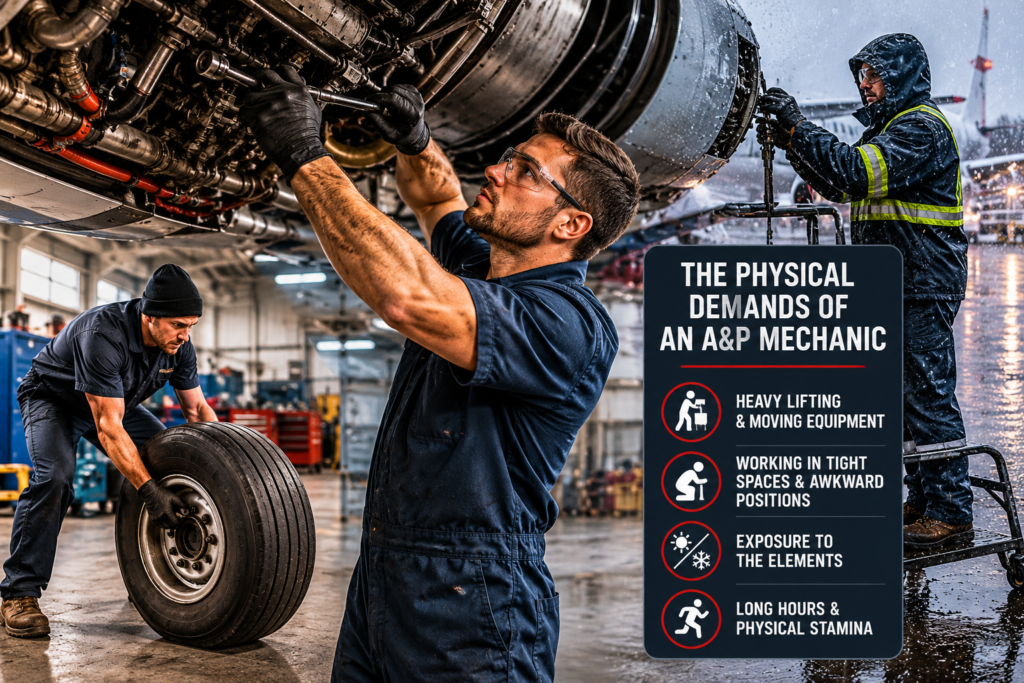
Aviation maintenance is physically demanding. Technicians must:
These physical requirements can be significant Barriers to Entry for an A&P Mechanic for individuals with mobility limitations or chronic injuries.
Many entry-level positions require:
For people with family obligations, this can be one of the lifestyle‑based Barriers to Entry for an A&P Mechanic.
Aircraft safety depends on the mechanic’s work. The responsibility is enormous. Some students underestimate the mental load, making this one of the psychological Barriers to Entry for an A&P Mechanic.
Not every region has an aviation maintenance school. Students may need to:
This geographic limitation is one of the structural Barriers to Entry for an A&P Mechanic.
For those pursuing the experience pathway, finding a shop willing to supervise and document training can be difficult. This lack of access becomes another one of the Barriers to Entry for an A&P Mechanic.
Many young people simply don’t know the career exists. High schools rarely promote aviation maintenance, and guidance counselors often lack information. This lack of visibility is one of the cultural Barriers to Entry for an A&P Mechanic.
Common misconceptions include:
These myths discourage potential students and contribute to the perception‑based Barriers to Entry for an A&P Mechanic.
Despite the many Barriers to Entry for an A&P Mechanic, the path is absolutely achievable. Here are practical ways students overcome them:
The industry is actively working to reduce the Barriers to Entry for an A&P Mechanic, especially as the global technician shortage grows.
Even with the challenges, the rewards are substantial:
For those who push through the Barriers to Entry for an A&P Mechanic, the career offers stability, pride, and long-term growth.
The Barriers to Entry for an A&P Mechanic are real — financial, educational, regulatory, physical, and cultural. But none of them are insurmountable. With proper planning, support, and determination, aspiring technicians can overcome these challenges and enter one of the most respected technical professions in aviation.
ARE YOU LOOKING FOR AN A&P JOB NOW? CHECK OUT AVIATION EMPLOYMENT NETWORK TO FIND JOBS.