Newsletter Subscribe
Enter your email address below and subscribe to our newsletter
Aviation Jobs Guide

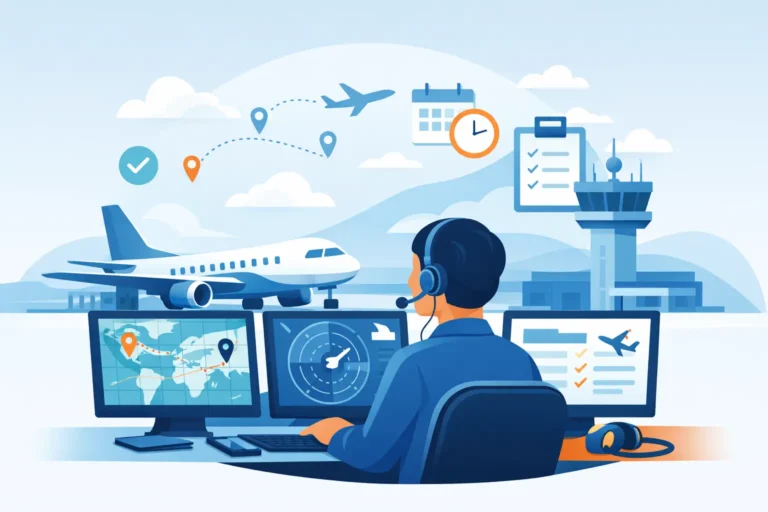
A Career in Flight Dispatch is one of the most operationally significant yet least understood professions in aviation. It is not clerical, not administrative, and not a support role. It is an operational discipline—one that carries legal authority, regulatory responsibility, and mission‑critical influence over every flight an airline operates. To understand A Career in Flight Dispatch, you must first understand the identity of the dispatcher, the mission they execute, and the operational authority they wield.
This section establishes the foundation for the entire pillar page: what dispatchers and flight followers actually are, why they exist, and how they function inside the nerve center of airline operations.
A Career in Flight Dispatch begins with a clear distinction between two roles that are often confused: the certificated Flight Dispatcher (Part 121) and the Flight Follower (Part 135). Both work in operations, both influence flights, and both support crews—but their authority, training, and regulatory responsibilities are fundamentally different.
The Part 121 Certificated Flight Dispatcher
Under 14 CFR Part 121, a Flight Dispatcher is a licensed aviation professional who shares joint legal responsibility with the Pilot in Command (PIC) for the safety and operational control of every flight. Dispatchers must:
This certificate grants operational authority similar in weight to a pilot certificate. Dispatchers are not assistants, coordinators, or administrators—they are operational decision‑makers whose signatures authorize aircraft to launch.
The Part 135 Flight Follower
Under Part 135, most operators are not required to employ certificated dispatchers. Instead, they use flight followers, whose responsibilities include:
However, flight followers do not:
A Career in Flight Dispatch may begin in Part 135, but the full professional identity is realized in Part 121, where dispatchers become legally accountable for the flights they release.
Mission — The Purpose Behind A Career in Flight Dispatch
The mission of the dispatcher is simple to state but complex to execute: Plan the flight, release the flight, and oversee the flight—ensuring safety, efficiency, and regulatory compliance.
This mission is the backbone of A Career in Flight Dispatch. Every decision a dispatcher makes must support three pillars: safety, efficiency, and regulatory compliance.
Safety
Safety is the dispatcher’s prime directive. Dispatchers evaluate:
Their decisions directly influence whether a flight is safe to operate. In A Career in Flight Dispatch, safety is not a slogan—it is a legal obligation.
Efficiency
Dispatchers are also responsible for operational efficiency:
A Career in Flight Dispatch requires balancing safety with efficiency, ensuring the airline operates reliably and economically.
Regulatory Compliance
Dispatchers must ensure every flight complies with:
Regulatory compliance is not optional. It is a core component of operational control.
The defining feature of A Career in Flight Dispatch is operational control. Under Part 121, dispatchers and pilots share joint responsibility for the safety of the flight. This is not symbolic—it is legal. Control responsibilities apply.
Operational control includes:
Dispatchers have the authority to delay, cancel, or reroute flights. Pilots cannot override dispatchers on matters of operational control. This shared authority is unique in aviation and central to A Career in Flight Dispatch.
The Flight Release
The flight release is a legal document signed by:
Both signatures carry equal weight. Both parties are responsible for the decisions made. This shared accountability defines the profession.
A Career in Flight Dispatch takes place inside the System Operations Control (SOC) or Operations Control Center (OCC)—the nerve center of the airline. This environment is the dispatcher’s cockpit.
The SOC Environment
The SOC is a high‑tech, high‑tempo operational hub where multiple departments converge:
Dispatchers sit at the center of this ecosystem, synthesizing information from every department to make real‑time decisions.
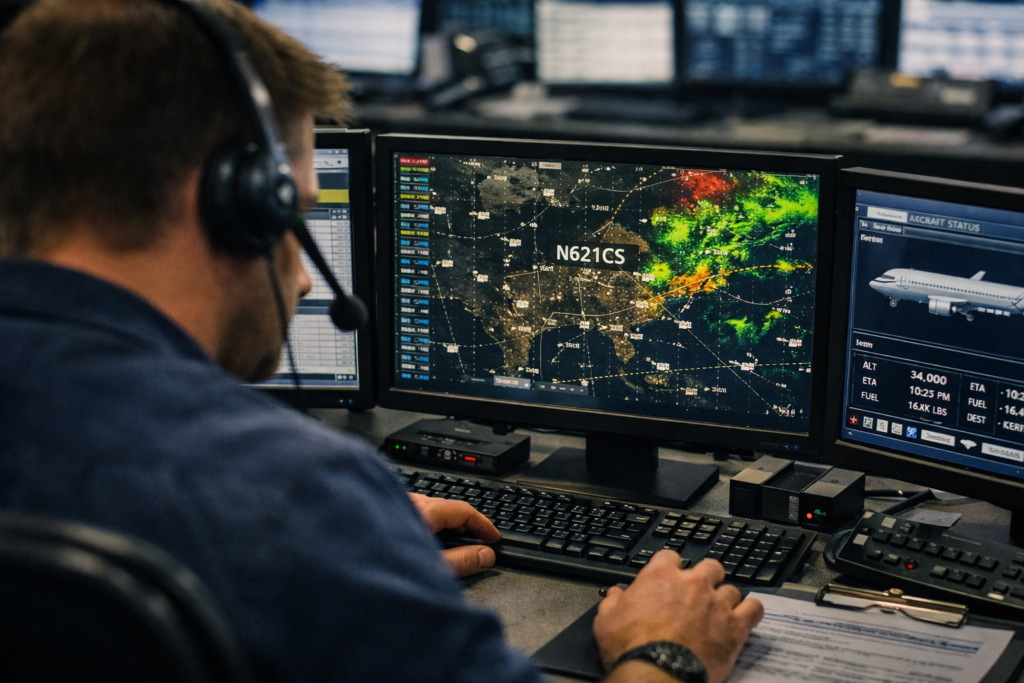
The Dispatcher’s Workstation
A dispatcher’s workstation includes:
This is the “hidden cockpit”—the place where dispatchers fly the airplane from the ground.
Why Dispatch Exists — The Operational Rationale
A Career in Flight Dispatch exists in north American flight control because aviation requires a ground‑based professional who can:
Pilots cannot do this alone. Airlines cannot do this without dispatch. The dispatcher is the operational strategist who ensures the airline runs safely and efficiently.
The Three Reasons Dispatch Exists
Without dispatch, modern airline operations would be chaotic, unsafe, and non‑compliant.
The Dispatcher Personality Profile
A Career in Flight Dispatch attracts a specific type of person. The role requires a unique blend of temperament, cognitive ability, and operational mindset. They must be able to apply responsibilities.
Calm Under Pressure
Dispatchers must remain calm during:
Calmness is not optional—it is a professional requirement.
Analytical and Systems‑Driven
Dispatchers think in systems:
Decisive Under Uncertainty
Dispatchers rarely have perfect information. They must:
This decisiveness is a defining trait of the profession.
The Hidden Cockpit — Making Decisions Without Being in the Airplane
One of the most compelling aspects of A Career in Flight Dispatch is the concept of the hidden cockpit. Dispatchers make cockpit‑level decisions without physically being in the aircraft.
Dispatchers:
But they do it from the ground, with broader situational awareness and fewer distractions.
Because dispatchers are not in the airplane, they can:
This is why A Career in Flight Dispatch is often described as “flying the airplane from the ground.”
A Career in Flight Dispatch is not administrative. It is not clerical. It is not support. It is an operational profession defined by:
Looking for airline dispatch jobs? Check out Aviation Employment Network to find a job!
What is a airlines flight follower? The airline do not usually use flight followers. They use certificated dispatchers. Flight followers are typically found at charter operations.