Newsletter Subscribe
Enter your email address below and subscribe to our newsletter

Aviation Jobs Guide
The total investment required to reach the flight deck of a major airline—encompassing the journey from a Private Pilot License (PPL) to an Airline Transport Pilot (ATP) certificate—is estimated to range between $\$85,000$ and $\$130,000$.
The economic landscape of professional pilot training in 2025 is defined by a paradox of high initial capital barriers and unprecedented long-term returns. As the aviation industry grapples with a systemic pilot shortage, the mechanisms for financing the transition from a student pilot to a commercial aviator have evolved into a sophisticated network of private lending, institutional sponsorship, and legislative support. The total investment required to reach the flight deck of a major airline—encompassing the journey from a Private Pilot License (PPL) to an Airline Transport Pilot (ATP) certificate—is estimated to range between $\$85,000$ and $\$130,000$. This analysis examines the diverse array of financial pathways available to aspiring professionals, evaluating the strategic implications of regulatory choices, lending architectures, and emerging tax-advantaged savings vehicles.
The financial architecture of flight training is built upon a sequence of increasingly specialized certifications, each requiring substantial outlays for aircraft rental, instructor fees, and examination costs. In 2025, these costs are subject to inflationary pressures on fuel and maintenance, yet they remain the baseline for any professional career in the cockpit.
The initial phase of training, the Private Pilot License (PPL), serves as the foundational investment. While the regulatory minimum for flight time is 40 hours under Part 61, most students require between 60 and 70 hours to reach proficiency, leading to a typical cost range of $\$14,000$ to $\$22,000$. Following the PPL, the Instrument Rating (IR) is a critical professional requirement, typically adding $\$9,000$ to $\$13,500$ to the total.
The Commercial Pilot License (CPL) represents the pivot point into paid employment. Obtaining a single-engine CPL costs between $\$22,000$ and $\$34,000$. However, professional utility is limited without a Multi-Engine (ME) rating, which typically requires an additional $\$ 6,000$ to $\$11,000$ for the add-on certification. To reach the 1,500-hour requirement for an ATP certificate, many pilots pursue Certified Flight Instructor (CFI, CFII, and MEI) ratings, which collectively represent an investment of $\$18,000$ to $\$ 28,000$.
| Training Stage | Estimated 2025 Cost Range (USD) | Standard Duration |
| Private Pilot License (PPL) | $$14,000 – $$22,000 | 3 – 6 Months |
| Instrument Rating (IR) | $$ 9,000 – $$13,500 | 2 – 4 Months |
| Commercial Pilot (Single-Engine) | $$22,000 – $$34,000 | 6 – 12 Months |
| Commercial Multi-Engine Add-On | $$ 6,000 – $$ 11,000 | 2 – 4 Weeks |
| Flight Instructor Ratings (CFI/CFII/MEI) | $$18,000 – $$28,000 | 4 – 6 Months |
| ATP Certification (CTP Course + Exams) | $$ 6,000 – $$ 11,000 | 1 – 2 Months |
| Total Professional Investment | $$85,000 – $$130,000+ | 18 – 24 Months |
Source:
Beyond tuition, the professional pilot must account for significant variable fees that contribute to the “zero-to-hero” total. Hourly aircraft rates vary significantly by model and region. As of late 2025, a Cessna 152 typically rents for $\$163$ per hour, while a glass-cockpit Cessna 172SP reaches $\$ 211$ per hour. Multi-engine aircraft, such as the Piper Seminole, are priced at approximately $\$ 454$ per hour.
Non-flight expenses are equally critical to budget accuracy. FAA written exams cost approximately $\$175$ per test, and practical exams (checkrides) paid to Designated Pilot Examiners (DPEs) have risen to a range of $\$ 1,000$ to $\$ 1,400$ per session. Professional gear, including a first-class medical exam ($$150 – $\$250), high-quality aviation headsets ($$ 500 – $\$ 1,500), and iPad EFB subscriptions ($$ 600+), adds several thousand dollars to the initial requirements.
| Item / Service | Estimated 2025 Rate (USD) |
| Cessna 172 Flight Time (Wet) | $$ 211 / \text{hour} |
| Multi-Engine Aircraft Time (Wet) | $$ 454 / \text{hour} |
| Flight/Ground Instruction | $$ 88 – $$ 95 / \text{hour} |
| FAA Checkride (DPE Fee) | $$ 1,000 – $$ 1,400 |
| FAA Knowledge Exam (PSI) | $$ 175 |
| First-Class Medical Exam | $$ 150 – $$ 250 |
| Professional Aviation Headset | $$ 500 – $$ 1,500 |
Source:
The regulatory framework under which a pilot trains—either Part 61 or Part 141—is not merely a curricular choice but a primary determinant of financial eligibility and total training duration.
Part 61 training is characterized by its flexibility, allowing for a personalized pace and “pay-as-you-go” funding, which appeals to those training while maintaining full-time employment. However, this flexibility requires a higher number of total flight hours for certification. In contrast, Part 141 schools utilize an FAA-approved, structured syllabus and must meet rigorous institutional standards for facilities and oversight.
The financial implication of the Part 141 structure is significant in the context of the Commercial Pilot License. While Part 61 requires 250 total flight hours for a CPL, Part 141 programs allow for certification in as few as 190 hours. This 60-hour reduction represents a potential savings of over $\$ 12,000$ in aircraft rental and instruction costs at modern rates.
Regulatory status often dictates the type of funding available to the student. Military veterans utilizing GI Bill benefits are generally required to enroll in approved Part 141 programs, particularly those associated with an accredited degree-granting institution. Furthermore, international students requiring M-1 visas must attend Part 141 schools. For domestic students, the transition of 529 plans into a viable flight training funding source is almost entirely contingent upon the school maintaining some form of accreditation, which is standard for collegiate Part 141 programs but rare for independent Part 61 operations.
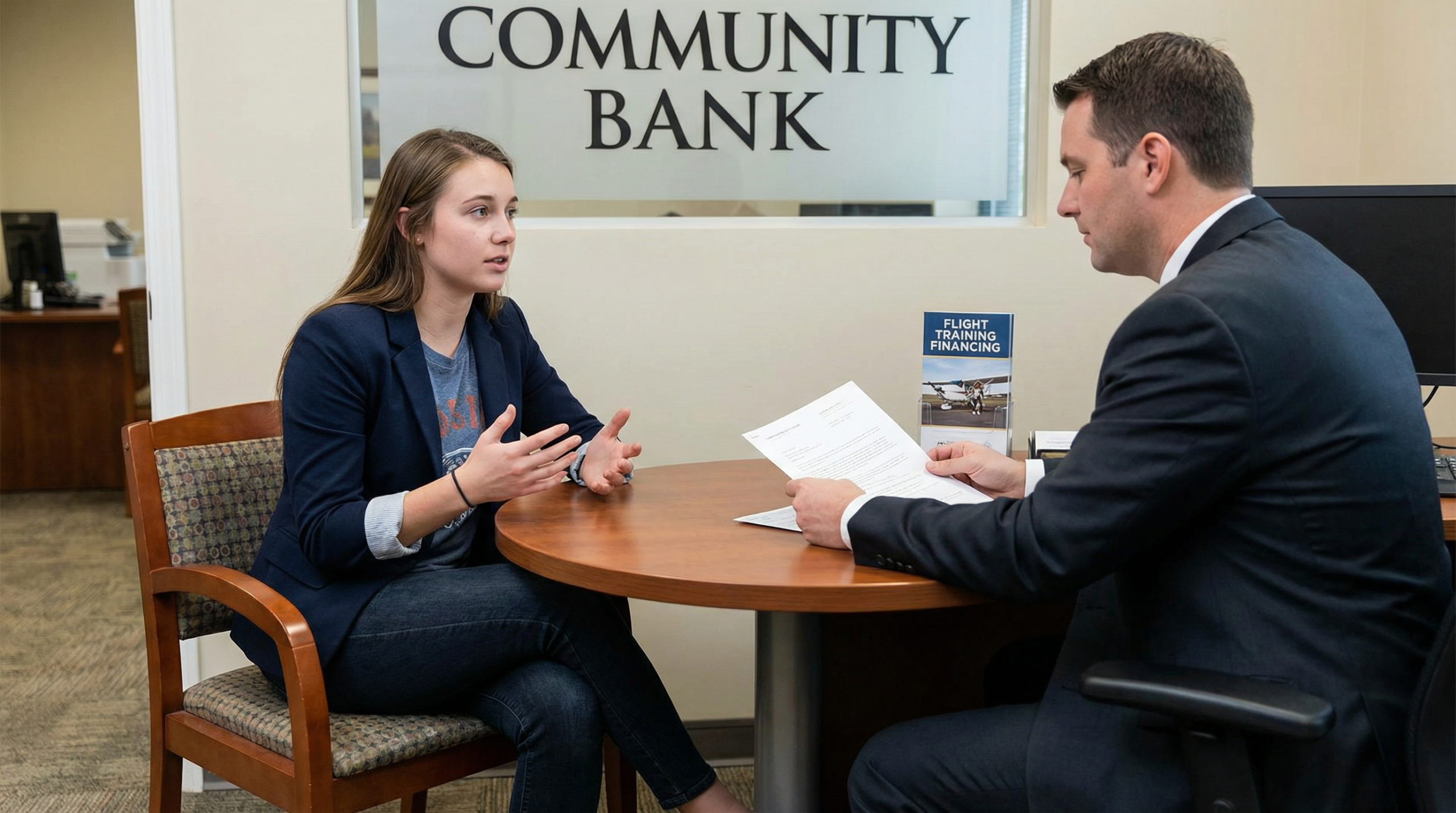
Because federal student aid is often restricted to traditional degree programs, the private lending market has developed specialized products designed for the unique lifecycle of a pilot’s training and subsequent career trajectory.
Sallie Mae remains the most prominent lender in the aviation sector, offering the “Airline Career Loan” specifically for students in qualifying professional pilot programs. This loan covers up to 100% of training costs, including ground school, aircraft hours, and license fees. A major professional advantage of this product is its 12-month grace period, which allows the pilot time to complete training and secure a flight instructor position before full principal-and-interest payments begin.
Stratus Financial has carved a niche by focusing exclusively on the aviation industry, often taking a more holistic view of an applicant’s potential than traditional credit-only lenders. Stratus lending packages are notable for their lack of a maximum loan limit, allowing students to finance the high tuition costs of “zero-to-hero” academies alongside housing and living expenses. Their underwriting considers a valid FAA Class 1 Medical as a key indicator of employability, effectively treating the student’s health as part of the credit assessment.
Meritize represents a shift toward “merit-based” underwriting. Rather than relying solely on a FICO score, Meritize uses a proprietary “Meritize Score” that rewards students for past academic achievements or military experience. For many aspiring pilots who may have limited current income but a strong record of discipline and performance, this model provides access to better interest rates and higher funding limits. Like other specialized lenders, they offer fully deferred payment options while in school and for three months after graduation.
Credit unions provide an alternative for students who may not qualify for national lender terms or who seek more localized service.
| Lender | Loan Limit / Type | Repayment Term | Key Requirement / Benefit |
| Sallie Mae | 100% of Costs | 15 Years | 12-month grace period; credit-based. |
| Stratus Financial | Unlimited (Full Financing) | Variable | Includes housing/stipend; Class 1 Medical required. |
| Meritize | Full Tuition + Living | Variable | Rewards academic history; soft credit pull. |
| WeFly | $\$30,000$ (Line of Credit) | 6 Years | Flexible for local schools; fixed rate. |
| AOPA Finance | $\$ 100,000$ | 7 Years | Requires AOPA membership; line of credit. |
| AA Credit Union | Up to $\$ 148,000$ | 25 Years | Must be in AA Cadet Academy; no payments during training. |
Source:
The most significant evolution in pilot funding in recent years is the rise of the airline-sponsored cadet academy. These programs combine training, financing, and a direct employment pathway into a single, cohesive institutional framework.
The United Aviate Academy is a “zero-to-hero” program designed to take students from no experience to a United Airlines flight deck. The total estimated cost for the core training certificates is $\$89,000$, but applicants must show “Proof of Funding” for at least $\$ 111,700$ to cover supplemental training and checkride fees. United facilitates scholarships through partner organizations like the Latino Pilots Association and Women in Aviation International to improve diversity and reduce the upfront burden.
This program provides a structured pathway to American’s wholly-owned regional carriers (Envoy, PSA, and Piedmont). The primary financial benefit is the partnership with the American Airlines Federal Credit Union, which offers 100% tuition financing with fixed rates and a two-year grace period after the training draw period ends. This long-term repayment structure (up to 25 years) significantly reduces the monthly debt-to-income ratio for new first officers.
Delta’s Propel program emphasizes four distinct paths, with the collegiate path being the most prominent. Students at partnered, AABI-accredited universities receive a Conditional Job Offer (CJO) for Endeavor Air and a guaranteed path to Delta mainline. While Delta provides less direct financing than United, it offers a scholarship path for referrals from affiliate organizations and provides unrivaled mentorship from current Delta pilots.
| Program | Partnership Scope | Key Financial Mechanism | Career Path |
| United Aviate | Integrated Academy | Scholarship partners; private loans. | United Airlines Mainline. |
| AA Cadet Academy | Regional & Flight Schools | AA Federal CU (25-year terms). | Envoy, PSA, Piedmont to American. |
| Delta Propel | Collegiate & CFI Paths | QJO for Endeavor Air; Scholarships. | Endeavor to Delta Mainline. |
| Horizon Pilot Dev. | Regional / Local | $\$12,500$ Financial Assistance. | Horizon Air to Alaska Airlines. |
Source:
Scholarships represent the primary source of non-repayable funding for flight training. In 2025, the landscape is divided between national aviation advocacy groups, identity-based organizations, and regional foundations.
The Aircraft Owners and Pilots Association (AOPA) and the Experimental Aircraft Association (EAA) are the pillars of pilot scholarships. AOPA awards over $\$1$ million annually, including a focus on high school students through the “You Can Fly” initiative, which provides $\$ 12,000$ awards for primary training. EAA provides similar levels of support, notably through the Ray Aviation Scholarship, which can cover the full cost of a Private Pilot Certificate for active members of EAA chapters.
Organizations dedicated to promoting diversity in the flight deck offer millions in annual funding:
Success in the scholarship market requires strict adherence to the application lifecycle. Most national organizations open their application windows in the autumn (September–December) with deadlines in early January or February. Awards are typically announced in the spring to align with the peak summer flying season. Beyond financial need, committees prioritize academic performance (minimum 2.7 GPA is standard), involvement in aviation activities, and a demonstrated commitment to passing FAA knowledge exams prior to application.
Public sector funding for flight training is increasingly being treated as a component of critical transportation infrastructure rather than traditional academic aid.
The FAA Reauthorization Act of 2024 has renewed the “Aircraft Pilots Workforce Development Grant Program” through fiscal year 2028. In 2025, this program allocated approximately $\$9$ million in competitive grants to organizations that support the recruitment and education of future pilots. These grants, which can reach up to $\$1$ million per award, are typically given to flight schools or community colleges to create scholarships, registered apprenticeship programs, or to purchase training simulators.
States with significant aviation industries have pioneered localized grant programs.
The most radical shift in aviation finance in decades occurred with the passage of Section 70414 in late 2024, which became effective for distributions in 2025. This legislation expanded the definition of “qualified postsecondary credentialing expenses” for 529 education savings plans to include occupational licenses recognized by the federal government, such as FAA pilot certificates.
For the first time, families who have saved in 529 plans can use those funds for flight training without paying income tax on the gains or the 10% early withdrawal penalty. This allows the tax-advantaged funding of:
The primary challenge of utilizing 529 funds is the institutional requirement. To accept these funds, a flight school must be an “eligible education provider,” which generally requires accreditation from a federally recognized agency. Currently, a vast majority of independent flight schools are unaccredited. However, the industry is moving quickly to address this; the International Aerospace Accrediting Commission (IAAC) is pursuing recognition by the U.S. Department of Education, which would allow a broader range of Part 141 flight schools to become 529-eligible by early 2026.
For members of the armed forces, the GI Bill provides one of the most powerful funding mechanisms for flight training, though its efficacy depends heavily on the training path selected.
The Post-9/11 GI Bill differentiates between training at a vocational flight school and a degree-granting collegiate program.
To maximize benefits, many veterans choose schools like US Aviation Academy or ATP, which maintain partnerships with accredited colleges like Liberty University or Tarrant County College. This structure allows the veteran to enroll in a degree program while conducting flight training at a specialized academy, ensuring that the VA recognizes the costs as part of a “recognized degree program”.
A unique feature of the aviation career path is the ability to recoup training costs after the initial investment through airline-sponsored reimbursement programs. As of 2025, regional airlines utilize these as a primary recruitment and retention strategy.
Regional airlines—which serve as the primary entry point for pilots who have completed their initial training—have more than doubled their starting pay in recent years. First-year regional first officers now earn between $\$80,000$ and $\$110,000$, making the debt service on private loans far more manageable than in previous decades.
Furthermore, many regional carriers offer direct tuition reimbursement or sign-on bonuses.
| Airline | First-Year Pay (Est. 2025) | Signing / Retention Bonus | Tuition Reimbursement |
| Envoy Air | $$ 106,200 | Up to $150\%$ Holiday Pay | $$ 6,000 + \text{ATP-CTP} |
| SkyWest | $$ 104,610 | $$ 5,000 | Up to $$ 15,000 |
| PSA Airlines | $$ 107,850 | Variable | Airline Alliance Program. |
| Horizon Air | $$ 99,090 | Variable | $$ 12,500 |
| Endeavor | $$ 110,382 | Delta Path Program | Path to Delta Mainline. |
Source:
While standalone flight schools are generally Title IV ineligible, students who pursue an aviation degree can access the full suite of federal student aid programs.
Enrolling in an aviation-related associate or bachelor’s degree program at an accredited university allows access to:
However, it is vital to note that even at degree-granting schools, federal aid may not cover the full cost of flight hours, which are often billed as “lab fees” on top of standard tuition. Most collegiate aviation students still require supplemental private loans or scholarships to cover the flight training portion of their education.
The decision to finance flight training through debt must be weighed against the projected lifetime earnings of a professional pilot. In 2025, the “return” on a $\$ 100,000$ training investment is historically high.
Seniority is the most valuable commodity in aviation, as it determines scheduling, equipment, and pay. The sooner a pilot completes training and starts their “longevity” clock at an airline, the higher their lifetime earnings potential.
The “opportunity cost” of delay is a critical financial metric. Saving for flight training by working a non-aviation job for 3-5 years may avoid debt, but it also means sacrificing 3-5 years of major airline captain salary and seniority at the end of a career. In a profession where seniority determines everything from quality of life to retirement payouts, the mathematical advantage often lies with those who finance their training early to maximize their time in the “left seat” of a major jet.
A modern flight training funding strategy requires a layered approach, utilizing “free” money first, tax-advantaged savings second, and institutional debt third.
The 2025 professional pilot training environment offers more diverse and flexible funding options than ever before. Through the strategic combination of private specialized lending, the recent 529 plan expansion, and the aggressive reimbursement programs of regional airlines, the financial barrier to the flight deck—while significant—has become a manageable investment in a high-return professional future.