Newsletter Subscribe
Enter your email address below and subscribe to our newsletter
AVIATION JOBS GUIDE

In the high-stakes world of aviation, safety is the ultimate currency. Whether an aircraft operates under Part 91 private ownership, Part 91K fractional programs, Part 135 charter, or Part 121 airline service, airworthiness is not optional. It is regulatory, procedural, and absolute. At the center of that responsibility are two distinct but interdependent professionals: the Airframe and Powerplant Mechanic vs Avionics Technician.
If you are evaluating a maintenance career path—or if you are a pilot seeking deeper appreciation for the technicians who sign the logbooks—understanding the differences between an Airframe and Powerplant Mechanic vs Avionics Technician is essential. Both roles protect the same mission. They simply approach it from different technical disciplines.

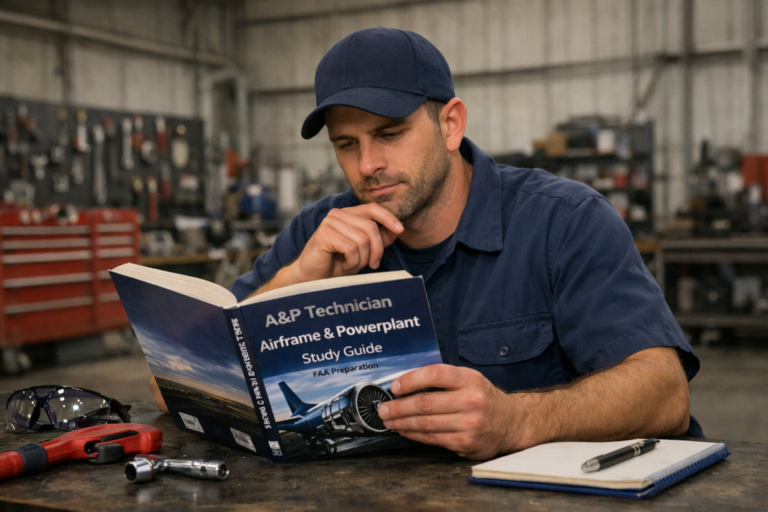
The A&P Mechanic is the general practitioner of the aviation world. Licensed by the FAA, these technicians hold the legal When discussing Airframe and Powerplant Mechanic vs Avionics Technician, the A&P represents the mechanical backbone of aviation maintenance.
An FAA-certificated Airframe and Powerplant mechanic holds legal authority under 14 CFR Part 65 to inspect, maintain, repair, and return aircraft to service. That authority is significant. The A&P signs the logbook. The A&P accepts regulatory accountability.
The “Airframe” rating covers virtually everything structural and mechanical outside the engine and specialized avionics systems.
This includes:
From corrosion inspection on a 40-year-old turboprop to composite skin repair on a next-generation business jet, the A&P works directly with the aircraft’s structural integrity. In many ways, they are architects of durability.
The “Powerplant” rating focuses on engines—piston, turboprop, and turbofan alike.
In general aviation environments, this might involve:
In turbine environments under Part 135 or Part 121, responsibilities expand to:
The A&P operates in physically demanding environments—inside wheel wells, on maintenance stands, and beneath cowlings. Tools are heavy-duty: torque wrenches, pneumatic rivet guns, hydraulic jacks. The work is tactile and mechanical.
When comparing Airframe and Powerplant Mechanic vs Avionics Technician, the A&P role is defined by structural logic and mechanical systems mastery.
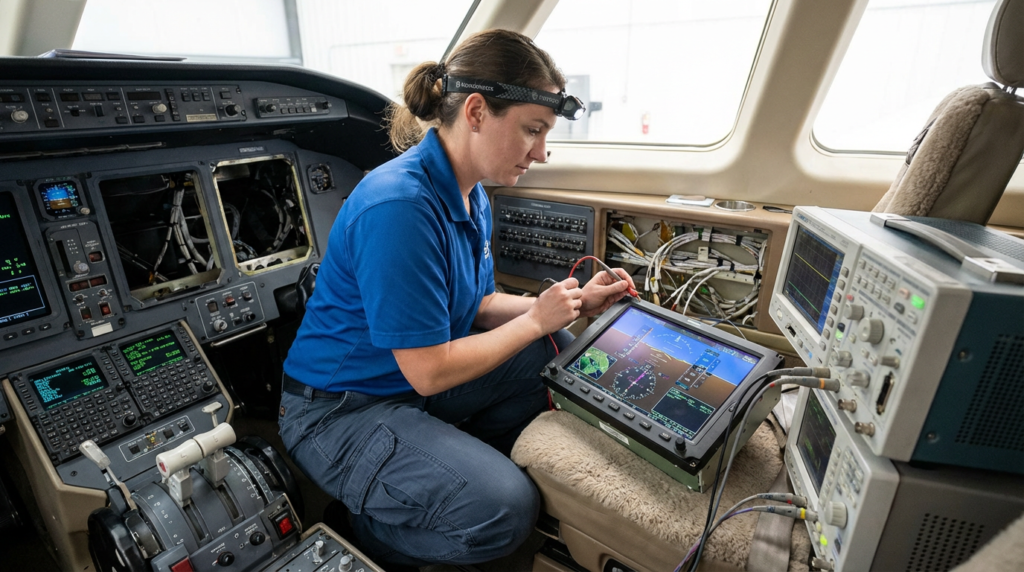
If the A&P maintains the aircraft’s structure and propulsion, the avionics technician safeguards its digital nervous system.
Modern aircraft are no longer purely mechanical machines. They are integrated electronic ecosystems. Flight management computers, GPS receivers, glass cockpit displays, autopilot systems, and data buses define modern operations.
In the discussion of Airframe and Powerplant Mechanic vs Avionics Technician, the avionics technician is the systems diagnostician.
Core avionics responsibilities include:
These systems are mission-critical for regulatory compliance and operational safety.
Modern aircraft rely on:
When a display fails or data becomes erratic, the avionics technician turns to diagnostic software, wiring schematics, and oscilloscopes. The tools are precise: multimeters, soldering stations, laptop-based test equipment, and signal generators.
Unlike the physically intensive A&P role, avionics work is often performed in electronics bays or cockpit interiors. It demands patience, circuitry comprehension, and comfort with logic-based troubleshooting.
In the context of Airframe and Powerplant Mechanic vs Avionics Technician, avionics specialists solve invisible problems—voltage irregularities, signal interference, software conflicts.
The distinction between Airframe and Powerplant Mechanic vs Avionics Technician becomes more nuanced across operational sectors.
Under private ownership, A&Ps often function as generalists. They perform annual inspections, manage owner expectations, and oversee maintenance schedules. Avionics technicians may work independently or as contracted specialists for upgrades and installations.
Relationships are personal. Accountability is direct.
In charter environments, dispatch reliability is paramount. Aircraft downtime equates to lost revenue.
Here, cross-discipline capability becomes valuable. Technicians who hold an A&P certificate and possess strong avionics troubleshooting skills are highly sought after. Rapid diagnosis and return-to-service authority matter.
Airline maintenance is highly specialized. A&Ps may focus exclusively on engines or landing gear. Avionics departments are separate and structured. Logistics, shift operations, and procedural standardization dominate.
The scale is industrial. Efficiency drives decision-making.
Understanding Airframe and Powerplant Mechanic vs Avionics Technician also requires examining credential pathways.
A&P Mechanic
Avionics Technician
The A&P license carries direct regulatory sign-off authority. Avionics certifications emphasize technical specialization.
When evaluating Airframe and Powerplant Mechanic vs Avionics Technician, career progression differs but remains robust for both.
A&P Career Path
Avionics Career Path
Hybrid professionals—A&P licensed technicians with advanced avionics capability—often command premium compensation and greater flexibility.
The choice between Airframe and Powerplant Mechanic vs Avionics Technician ultimately depends on cognitive preference.
Choose the A&P route if you think mechanically. If you enjoy structural systems, hands-on repair, and visible results, the A&P path offers direct authority and tangible accomplishment.
Choose avionics if you think electronically. If circuit boards, software integration, and digital diagnostics fascinate you, avionics aligns with the future trajectory of aviation technology.
Aircraft are becoming increasingly automated, data-driven, and electronically integrated. Yet they still rely on structural integrity and propulsion reliability. Both professions are indispensable.
The aviation industry faces a significant technician shortage across maintenance disciplines. Retirements, fleet expansion, and increased aircraft complexity continue to drive demand.
Whether examining Airframe and Powerplant Mechanic vs Avionics Technician, both career paths offer:
Most importantly, both roles carry a unique professional weight: the authority to determine whether an aircraft is safe to return to service.
The debate over Airframe and Powerplant Mechanic vs Avionics Technician is not about superiority. It is about specialization.
The aircraft does not care which discipline you represent. It responds only to precision, discipline, and professional integrity.
One maintains the structure and propulsion that keep the aircraft physically airborne.
The other ensures the digital systems that guide, communicate, and automate the flight function flawlessly.
Together, they form the backbone of aviation safety.
And without either one, the aircraft does not leave the ground.