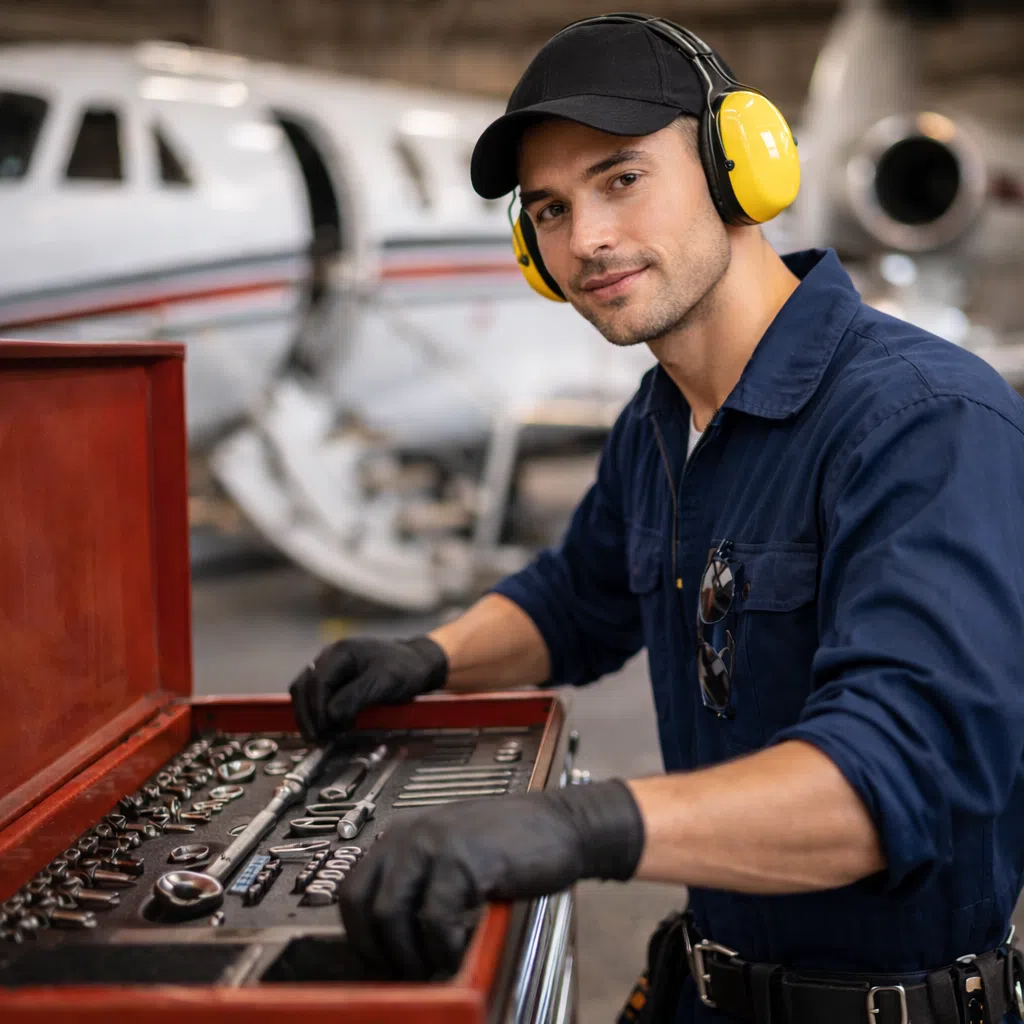
— What Newcomers, Instructors, Evaluators, Experienced Technicians, and Retirees Want You to Understand
There is a certain kind of person who stands near an airplane and does not first think about the destination. He thinks about the machine. She notices the access panels, the rivet lines, the landing gear geometry, the strange elegance of systems hidden beneath metal skin. The pilot may see freedom. The passenger may see speed. The traveler may see convenience. But the future maintenance professional sees something else entirely. He sees complexity. She sees consequence. Both, if they are paying attention, begin to understand that aviation does not run on romance alone.
That is where many aviation maintenance careers truly begin. Not in a classroom, and not even in a hangar, but in a shift of attention. The aircraft stops being a symbol and becomes a system. Then the system becomes a responsibility.
A great deal of online content about aviation maintenance careers is thin, repetitive, and bloodless. It tells you that mechanics inspect airplanes, repair components, and earn certifications. All of that is true. None of it is enough. It is not enough because this profession is not just a set of tasks. It is a culture, a standard, a way of thinking, and for many people a life lived in the company of machines that do not forgive carelessness.
To understand aviation maintenance careers, you have to see them from several vantage points at once.
You have to understand what the newcomer imagines the field to be. You have to hear what the instructor wishes students knew sooner. You have to recognize what evaluators are actually measuring when they watch a person work. You have to listen to the technician five years in, the one who has lost a few illusions and gained a little scar tissue. You have to hear from the ten-year veteran, the crew chief, the inspector, the person who now understands that judgment matters as much as technical ability. And if you really want depth, you have to ask the retiree what stayed with him after the years passed and the tools were put away.
That is the approach here.
This is not merely a guide to aviation maintenance careers. It is an attempt to explain the profession from the inside out.
The View from Outside the Hangar
From outside the hangar, aviation maintenance can look straightforward. Airplanes come in. Technicians inspect them. Wrenches turn. Panels open and close. A problem is found, a part is replaced, the logbook is signed, and the aircraft returns to service. For the casual observer, that may seem like the whole picture.
It is not.
The real work of aviation maintenance careers lives in the spaces outsiders do not easily see. It lives in procedure. In technical references. In tolerances. In system logic. In documentation. In judgment calls that are not guesses but disciplined conclusions drawn from knowledge, experience, and standards. It lives in knowing when something is serviceable, when it is not, when a discrepancy matters immediately, and when a symptom is pointing to a deeper issue waiting to reveal itself.
The outsider often sees motion. The insider sees accountability.
This matters because many people are attracted to aviation maintenance careers for good reasons, but incomplete reasons. They love airplanes. They like tools. They want a technical trade. They want to work around aircraft. Those are reasonable starting points. But they are not yet the profession. They are only the doorway.
The profession begins when fascination matures into discipline.
What Wannabes Usually Think Aviation Maintenance Careers Are
The person standing at the threshold of the field often imagines aviation maintenance careers in a few predictable ways. He imagines engines, sheet metal, troubleshooting, and hangar life. She imagines being close to airplanes, building skill, maybe wearing coveralls with a company patch, maybe working on something large and important and tangible. There is pride in that vision, and there should be.
But there are also gaps in it.
The wannabe often imagines action more than repetition. He imagines solving dramatic problems, not checking the same systems again and again because standards do not care whether a task feels exciting. She imagines technical work, but not always the documentation that stands behind it. He imagines learning components, not yet appreciating that the real craft is often in diagnosis, not replacement. She imagines entering aviation, but not necessarily the physical wear, the odd hours, the weather exposure, the fatigue, or the patience required to build actual competence.
This does not mean the beginner is naive in some insulting way. It means the beginner is early. That is different.
Most people first approach aviation maintenance careers through the visible surface of the job. They see airplanes and mechanical skill. Later, if they stay, they begin to see the deeper structure beneath the trade. They begin to understand that aviation maintenance is as much about trustworthiness as talent. An employer can teach a task. He is slower to fix a person whose habits are careless. An instructor can correct a procedure. It is harder to reshape character.
The strongest newcomers eventually realize that this field does not reward swagger for very long. It rewards humility, consistency, and technical seriousness.
The First Hard Truth: Loving Airplanes Is Not Enough
Many people enter the field because they love airplanes. That affection is not a bad thing. In fact, it can be a powerful source of motivation. But on its own, it is not enough to sustain a long career.
Airplanes are beautiful from a distance. Up close, they become demanding.
An aircraft does not care that you are enthusiastic. A maintenance task does not become easier because you are passionate. A discrepancy does not resolve itself because you are proud to be working in aviation. The machine requires something more concrete from you than admiration. It requires exactness.
This is one of the earliest separations in aviation maintenance careers. Some people are drawn by the image of the industry. Others are drawn by the actual work of the industry. The first group may admire airplanes. The second group is willing to live inside standards.
That difference becomes obvious quickly in school, in training, in apprenticeships, and on the hangar floor. Some people love talking about aviation. Others can quietly open a manual, trace a system, inspect a component, and do what the task requires without needing excitement to carry them.
That second person usually has a future.
What Instructors Wish New Students Understood Earlier
Ask enough instructors what they wish students understood sooner, and a pattern appears. They do not usually say they wish students came in knowing more. Knowledge can be taught. They usually wish students came in with a more realistic understanding of what the profession requires.
Instructors in aviation maintenance programs often see students who are fascinated by aircraft but underprepared for the discipline of technical training. Some students want quick answers when the field demands methodical thinking. Some want the prestige of aviation without the grind of competence. Some underestimate reading comprehension, communication, and reference use. Some think good hands are enough. Some do not yet understand that the ability to follow procedure carefully is not a sign of weakness or lack of creativity. In this field, it is professionalism.
The best instructors know that aviation maintenance careers are not built just by passing tests. They are built by shaping habits. They watch how students approach a task when no one is rushing them. They watch how they handle uncertainty. They watch whether a student guesses, skips, assumes, or checks. They notice whether a student takes correction personally or uses it to improve. They notice whether the student respects the reference material or treats it like an obstacle.
A strong instructor is not merely teaching torque values, electrical theory, or inspection procedures. He is also trying to shape a maintenance mind.
That maintenance mind is careful but not timid. It is systematic without being robotic. It does not pretend to know what it does not know. It respects experience but does not worship bad habits merely because they are old. It recognizes that technical skill is inseparable from personal discipline.
This is why good instructors can be so influential in aviation maintenance careers. Long after students forget exact classroom language, they often remember the standards those instructors insisted on.
School Teaches Skills, but It Also Reveals Character
Training programs are often described in practical terms: coursework, labs, systems, structures, engines, electrical, regulations, inspections, troubleshooting. All of that matters. But school does something else that is less often discussed. It reveals who the student is under standards.
The student who is late to class, careless with notes, disorganized with tools, casual about reference materials, or defensive under critique is already telling the future a story. The story may yet improve, but it is being written early.
In aviation maintenance careers, little habits become large outcomes. The person who does not double-check in training may eventually fail to double-check where it matters more. The student who resents procedure may later become the technician others do not quite trust. The student who keeps asking good questions, who reads before acting, who takes correction and returns stronger, may not look flashy at first, but often becomes the dependable one.
That is another truth beginners need to hear. Early promise in this field is not always loud. It is often quiet. It looks like consistency. It looks like care. It looks like a person slowly becoming trustworthy.
What Evaluators and Inspectors Are Really Looking For
The evaluator occupies a different vantage point from the instructor. The instructor is still building. The evaluator is measuring. He may be checking knowledge, procedure, judgment, workmanship, documentation, or compliance. But beneath all of those categories lies a deeper question: can this person be trusted in a real maintenance environment?
That is what many outsiders miss. Evaluators are not simply looking for whether the candidate can complete a task. They are watching how the task is approached.
Does the candidate use the proper reference?
Does the candidate understand the sequence of work?
Does the candidate recognize when a condition is beyond limits?
Does the candidate make unsupported assumptions?
Does the candidate document clearly?
Does the candidate display control over the work, or merely movement around it?
In aviation maintenance careers, a person can look busy and still be unsafe. He can appear confident and still be careless. He can speak fluently and still be technically weak. Evaluators understand this, which is why they often pay close attention to the things the candidate does between the obvious steps.
A good evaluator is not impressed by theatrics. He is impressed by sound habits.
This is why some people who seemed strong in casual settings can struggle when formally assessed. The evaluation environment strips away the atmosphere and reveals the foundation. The person who relied on bluff suddenly finds there is nowhere to hide. The person who seemed quiet but steady often performs better because the habits were real all along.
For anyone considering aviation maintenance careers, this is important. The field is not simply testing what you know. It is constantly, in one form or another, testing how you think.
The Invisible Skill: Judgment
If a newcomer asked what the most underrated skill in aviation maintenance careers is, a veteran might answer without hesitation: judgment.
Technical skill matters, of course. So do knowledge, certifications, experience, and practical ability. But judgment is what ties them together. Judgment is the disciplined ability to interpret a situation correctly, choose an appropriate course of action, and know when to proceed, stop, escalate, verify, or defer.
The person with poor judgment can be dangerous even when technically capable. The person with strong judgment may not know everything, but he knows how to behave when he does not know. That difference can protect aircraft, teams, schedules, and lives.
Judgment develops slowly. It is one of the great accumulations in aviation maintenance careers. It is formed by training, repetition, mentorship, error, correction, exposure to consequence, and deep respect for standards. It is sharpened by seeing what rushed work looks like. It is clarified by watching strong technicians work through uncertainty without arrogance. It is reinforced by environments where quality matters more than appearances.
This is one reason experienced maintenance professionals are so valuable. Their value is not only in what they can do with their hands. It is in the decisions they make before the hands move.
How to Get Started in Aviation Maintenance Careers
A pillar page on aviation maintenance careers has to do more than describe the soul of the profession. At some point, a reader needs a real map.
How do you actually begin?
Most people enter aviation maintenance careers through one of three main routes. The first is formal civilian training through an aviation maintenance school. The second is military maintenance experience, followed by whatever transition is necessary to align that experience with civilian credentials and employer expectations. The third is a less direct route through adjacent technical fields such as automotive, diesel, industrial maintenance, manufacturing, or electronics, followed by specialized aviation training or qualifying experience.
For many civilian entrants, the structured training route is the clearest. It exposes students to the technical baseline they will need to understand aircraft systems, inspection procedures, powerplants, structures, electrical theory, and regulatory expectations. Just as importantly, it begins to train them to work from approved data and technical references rather than from instinct or borrowed confidence.
But no matter the route, getting in is only the first phase. Aviation maintenance careers are built in layers. Entry matters. So does the first environment. So does who trains you after school. So does whether your early habits become professional habits or permanent liabilities.
The right way to think about entering the field is not merely, “How do I get a job around airplanes?” The better question is, “How do I build a foundation strong enough to grow from?”
The A&P Pathway: The Most Recognized Route

For many people exploring aviation maintenance careers, the Airframe and Powerplant route is the obvious starting point. There is a reason for that. The A&P remains one of the most recognized and versatile foundations in civilian aircraft maintenance. It signals a broad base of knowledge across aircraft structures, systems, engines, inspections, and practical maintenance work.
That does not mean the A&P is a magic passport. A certificate is not the same thing as competence. The newly certificated mechanic still has a great deal to learn in the real world. But the A&P does matter. It opens doors. It gives employers a familiar benchmark. It provides a recognized starting point from which a technician can grow into line maintenance, base maintenance, corporate aviation, general aviation, MRO environments, and eventually inspection, troubleshooting, leadership, or specialized work.
The mistake some newcomers make is imagining that the A&P is the finish line. It is not. It is a platform. It tells the industry that you have begun formal alignment with the standards of the trade. After that, the career becomes about how you build on it.
A strong A&P does more than pass tests. He becomes proficient with references. She becomes reliable in documentation. He learns how actual operations feel under pressure. She begins to understand the difference between school exercises and real maintenance consequences. That is where the certificate becomes a profession.
The Avionics Pathway: The Systems Thinker’s Route

Not all aviation maintenance careers center on the same kind of work. Some people are drawn less to structures and engines and more to electrical logic, integration, signal flow, communication systems, navigation systems, instrument behavior, and troubleshooting in environments where the problem is not always visible to the eye.
Those people often find their way toward avionics.
Avionics careers appeal to a certain type of technician. Often this is someone who enjoys systems that must be reasoned through rather than merely looked at. Someone patient. Someone methodical. Someone who does not panic when a problem is buried three levels deep inside a chain of indications, inputs, outputs, and interface logic. The avionics world can be deeply satisfying for those minds because it rewards diagnostic discipline.
It also carries its own frustrations. Troubleshooting can be slow. Intermittent faults can be maddening. Documentation matters immensely. Assumptions can waste hours. A technician who prefers immediate visual problems may find avionics less natural. But the person who likes invisible logic and coherent system behavior may find a long future there.
This is one of the important truths about aviation maintenance careers: they are not one profession expressed one way. They are a family of technical roles connected by standards, responsibility, and consequence, but different in how the work feels from the inside.
Other Specialties in Aviation Maintenance Careers
Outsiders often reduce aviation maintenance careers to “aircraft mechanic,” as though that were one narrow identity. In reality, the field is much broader. Within the maintenance world, people branch in different directions according to aptitude, temperament, opportunity, and long-term strategy.
Some technicians develop into structures specialists. They become highly proficient in repair techniques, sheet metal work, fit, finish, corrosion evaluation, and restoration of airworthiness in places where precision and workmanship matter immensely. Others lean toward engines and powerplant systems, where performance, reliability, and diagnostic clarity drive the work. Others become excellent inspectors or quality professionals, natural guardians of standards who see details other people miss. Others move toward component repair, interiors, planning, records, maintenance control, reliability, technical publications, or field service support.
Each specialty changes the feel of the work.
A structures technician may take pride in precise physical workmanship. A troubleshooter may take pride in solving the problem nobody else could isolate. An inspector may take pride in preventing hidden risk from becoming accepted practice. A planner may take pride in bringing order to maintenance activity at a systems level. A maintenance controller may sit at the operational intersection where schedules, discrepancies, logistics, and technical judgment collide.
All of these are real expressions of aviation maintenance careers. The field is wider than the beginner first imagines.
The First Two Years: Excitement, Humility, and Repetition
The first two years of a maintenance career can be exhilarating and sobering at the same time. The newcomer has finally entered the world that once seemed distant. The badge is real. The aircraft are real. The work is real. And almost immediately, so is the humility.
This stage in aviation maintenance careers is often where romance begins to burn off and reality begins to settle in. That is not bad news. It is necessary news.
The new technician discovers that there is far more to know than school could possibly provide. He learns that even familiar tasks can become unfamiliar when performed on real equipment under operational pressure. She learns that the hangar has its own language, its own pace, its own informal hierarchies, and its own unwritten tests. He learns that every team has strong people, weak people, teachers, complainers, craftsmen, corner-cutters, and quiet professionals who can make a complex problem look simple because they have been living inside it for years.
The early-career technician is often torn between wanting to prove himself and realizing how much he still needs to learn. That tension is healthy if it leads to humility rather than paralysis. The best new people in aviation maintenance careers are not those who pretend to already belong at the highest level. They are those who show that they are teachable, reliable, observant, and serious about growing.
Repetition is a major part of this stage. To an outsider, repetition can sound boring. To the profession, repetition is how consistency is built. Repetition teaches rhythm. Repetition makes references familiar. Repetition trains the hands and eyes. Repetition also exposes whether a person can maintain standards when the task no longer feels novel.
That matters because aviation maintenance is not performed for entertainment. It is performed for airworthiness.
What Early-Career Technicians Learn Fast
By the time someone has been working for a year or two, a few truths usually become clear.
First, not every maintenance environment is equally healthy. Some shops are disciplined and professional. Some are sloppy, political, rushed, or unevenly led. The new technician learns quickly that culture matters. Two employers may both offer aviation maintenance jobs, but the quality of life, skill growth, and professional standards can be radically different.
Second, the technician learns that reputation forms early. In aviation maintenance careers, people notice who can be counted on. They notice who shows up prepared. They notice who reads, who rushes, who hides mistakes, who asks smart questions, who blames others, who helps, and who creates more work than he solves. Fair or unfair, reputations tend to form quickly because the work is consequential.
Third, the technician discovers that confidence must be earned honestly. False confidence is common in immature people and exhausting to everyone around them. Real confidence grows out of competence, pattern recognition, and judgment. It is usually quieter than beginners expect.
Fourth, the young technician learns that paperwork is not the enemy of real work. Documentation is part of the work. That lesson can take time. Some newcomers initially think the mechanical side is the true job and the recordkeeping is an administrative nuisance. Experienced people know better. In aviation maintenance careers, poor records can be as damaging as poor wrench work.
Choosing the Right First Environment
This point deserves more attention than it usually gets.
A beginner often thinks the biggest problem is simply getting hired. That is understandable. But in aviation maintenance careers, the first environment can shape the next decade. A strong first environment can accelerate growth. A weak one can normalize habits that later have to be painfully unlearned.
A good first environment is not necessarily the flashiest one. It is not always the one with the most glamorous aircraft or the most impressive logo. It is the one where standards are taken seriously, where references are respected, where experienced people still care, where new technicians can ask questions without being shamed for ignorance, and where rushed work does not masquerade as professionalism.
A bad first environment usually reveals itself in recognizable ways. References are treated as optional. Documentation is sloppy. Informal shortcuts dominate. Strong people are tired or cynical. Weak people are protected by chaos. New hires are expected to “figure it out” without real mentorship. Quality is discussed but not defended.
A young technician may not fully understand culture on day one, but he will feel it soon enough. One of the most valuable skills in aviation maintenance careers is learning how to read an environment. The aircraft matter. The certificates matter. The pay matters. But culture may matter most of all.
The Major Work Environments in Aviation Maintenance Careers
Aviation maintenance careers unfold across several major sectors, and each creates a different daily reality.
General aviation can be broad, practical, and highly educational. A technician may see a wide variety of piston aircraft, owner-operated aircraft, older systems, unusual discrepancies, and hands-on troubleshooting. This environment can build broad practical instincts, but resources, procedures, pay, and workload can vary dramatically from one shop to another.
Airline maintenance tends to operate at scale. Procedures are structured. The consequences of delay are immediate. Reliability, coordination, and consistency matter constantly. This environment can suit people who appreciate large systems, organizational clarity, and the weight of commercial transport. It may also feel more specialized and less intimate than smaller sectors.
Corporate and business aviation often operate at a high standard of presentation, professionalism, and customer sensitivity. Depending on the operation, technicians may need broad competence, strong discretion, and an understanding that aircraft condition is tied not only to safety but also to service expectations. Some technicians thrive in this world because it blends technical rigor with high-end operational standards.
Repair stations and MRO facilities can offer deep technical exposure, especially in heavy maintenance, component work, structures, powerplant tasks, and large-scale scheduled events. These environments can be excellent for skill development, especially for those who want deep immersion in complex maintenance activity rather than fast-turn line support.
Manufacturing and production environments attract a different profile. Here the work may be less about in-service discrepancies and more about build quality, process control, conformity, and precision in a production system. Some technicians love this clarity. Others prefer the messier diagnostic world of operational aircraft.
Government, defense-adjacent, and public service environments can bring mission identity, procedural discipline, and specialized aircraft or support structures. These environments may appeal to those who value purpose, organization, and long-term stability.
Each of these sectors contains legitimate aviation maintenance careers. The right choice depends less on prestige than on fit.
Five Years In: When the Career Becomes Real
Five years is an interesting point in aviation maintenance careers because it is often the stage when a technician stops living on beginner energy and starts confronting larger professional questions.
By five years, many people can no longer rely on being “new” as an identity. They have enough exposure to understand the field better and enough experience to know how much they still do not know. This can be a healthy stage or a dangerous one.
It is healthy when the technician has used the first years to build a solid base and is now beginning to think like a professional rather than a trainee. He sees patterns faster. She understands common failure modes. He can navigate manuals and references with less hesitation. She knows how operations feel when pressure rises. He may start mentoring newer people in small ways. She becomes more valuable not only because she can perform tasks, but because she can see the shape of problems earlier.
It is dangerous when the technician becomes overfamiliar and underdisciplined. This is the stage where bad habits can harden. A person who has enough skill to move quickly but not enough maturity to remain careful can become risky. In aviation maintenance careers, complacency is one of the profession’s permanent enemies. By year five, the battle against it becomes more personal.
This is also the stage when career identity starts to branch. Some technicians begin leaning toward engines. Some toward structures. Some toward avionics. Some toward inspection. Some toward troubleshooting. Some discover a talent for leadership. Some realize they are excellent workers but poor mentors. Some see the limits of a certain employer and begin thinking strategically about where the next chapter should unfold.
At five years, the career is no longer theoretical. It has shape now. The question is whether the shape is intentional.
What the Five-Year Technician Knows That the Beginner Does Not

The five-year technician has usually learned that the job is not a movie. It is a long relationship with standards. He knows that frustration is part of the field. Parts delays happen. Miscommunication happens. Shift changes happen. Weather, management, budgets, tooling limitations, human weakness, and operational urgency all complicate what looked clean on paper.
He also knows that the best people in aviation maintenance careers are rarely the loudest. Some of the strongest technicians are not particularly charismatic. They are simply dependable under pressure. They know what good work looks like. They know what bad work smells like before it fully reveals itself. They keep the aircraft moving safely and the operation from drifting into chaos.
The five-year technician also begins to understand the cost of poor culture. A weak manager can drive away strong mechanics. A rushed environment can normalize shortcuts. A cynical team can poison young talent. A good lead can shape a generation. These truths are not always visible from the outside, but they deeply affect real aviation maintenance careers.
This is often when the technician starts asking more mature questions. Not just “How do I get in?” but “What environment will make me better?” Not just “What pays more right now?” but “What path builds durable value?” Not just “Can I do the work?” but “What kind of maintenance professional am I becoming?”
Those are better questions, and the profession opens differently when asked that way.
Ten Years In: Specialization, Leadership, or Stagnation
At around ten years, another separation often appears. People who once looked similar on paper can be living very different careers.
One technician may have become a deeply capable troubleshooter whose value rises every year because he can diagnose complex issues others struggle to interpret. Another may have specialized in avionics, composites, powerplant work, structures, planning, or quality. Another may have moved into inspection or supervision. Another may have remained in largely the same place, doing familiar work competently but without much strategic development. Another may be burned out. Another may be quietly elite.
This is one of the most revealing phases in aviation maintenance careers. Experience alone does not guarantee growth. Ten years can produce mastery, or it can produce habit. The difference often comes down to mindset, mentorship, opportunity, and whether the person kept learning after the early hunger faded.
By this point, leadership begins to matter more. Even technicians who never move formally into management begin influencing the culture around them. Younger people watch them. Teams depend on them. Their standards become contagious, for good or ill. A ten-year mechanic who still treats the work with seriousness can anchor a shop. One who has given in to cynicism can degrade it.
This stage also forces practical decisions. Does the technician want to stay hands-on? Move into inspection? Shift toward management? Join a manufacturer? Go to a major airline? Work corporate aviation? Pursue a specialty? Teach? Build toward director-level responsibility? Change sectors entirely?
Because aviation maintenance careers are broader than many people realize, ten years does not have to mean doing exactly what one was doing at year two, only with older knees. The field offers forks in the road. But those forks become visible mostly to people who built enough credibility to approach them.
The Difference Between Experience and Depth
One of the quiet truths of the maintenance world is that years in the field and depth in the field are not the same thing.
A person can spend ten years doing narrow, repetitive work and still lack broader professional judgment. Another person can spend fewer years in demanding environments, under strong mentors, with constant exposure to standards and complex systems, and emerge far more mature. This is not a criticism of longevity. Longevity matters. It is a reminder that the content of experience matters as much as its duration.
In aviation maintenance careers, depth usually comes from a combination of factors. Exposure to varied systems helps. So does responsibility. So does working in environments where corners are not normalized. So does being around people who take pride in getting it right. So does intellectual curiosity. So does the willingness to say, even after years in the trade, “I need to verify this.”
This is why some veterans remain humble. The more they understand the field, the less they are tempted by false certainty. They know enough to know what they do not know. That kind of maturity is one of the profession’s finest qualities.
What Employers and Hiring Managers Actually Want
From the outside, job postings for aviation maintenance careers can make hiring seem transactional. Certificates, years of experience, shift availability, tooling, airframe familiarity, troubleshooting ability. Those things matter. But employers who have lived in this world for a while usually want more than a list of qualifications.
They want someone they can trust on the line, in the hangar, on nights, during pressure, after schedule changes, when parts are late, when communication is thin, when the discrepancy is vague, when the answer is not obvious, when the aircraft matters to a demanding customer or a complex operation.
Hiring managers in aviation maintenance careers are often trying to assess a deeper set of traits, even if the posting cannot say all of them cleanly. They want professionalism. They want judgment. They want documentation discipline. They want someone who is still teachable. They want someone who can fit into a team without lowering its standard. They want someone whose confidence is proportionate to competence. They want someone who does not create hidden risk.
This is why interviews in the field can be revealing. The strongest candidates often do not oversell themselves. They communicate clearly. They understand what they have done and what they have not done. They can speak to systems, tasks, and environments in grounded language. They do not need to posture. They sound like people who know that the work is serious.
That kind of credibility compounds over time. In aviation maintenance careers, a strong name can carry surprising weight.
Salary, Advancement, and Long-Term Earning Power
Anyone searching aviation maintenance careers eventually wants to know the practical question: what can this profession become financially?
That is a fair question, but it should be asked carefully. Aviation maintenance compensation varies widely depending on sector, geography, shift, experience, certifications, union environment, overtime, specialization, leadership level, and whether the role is line, base, corporate, airline, MRO, manufacturing, or management. A newcomer who reads one number online can form an unrealistic picture in either direction.
The better way to think about earnings in aviation maintenance careers is in layers.
At the entry level, the pay may not yet reflect the eventual responsibility a technician will carry. This can frustrate new entrants. But as competence, certifications, reliability, and specialization accumulate, earning power tends to improve. The technician who becomes valuable in a way the operation can feel often rises faster than the technician who merely occupies a slot.
Specialty matters. Sector matters. Overtime can matter significantly. Geographic mobility can matter. So can willingness to work nights, travel, respond to line demands, or move into higher-responsibility roles. Over a long arc, the field can provide solid, respectable income and a durable technical livelihood. For some, especially those who combine strong technical ability with inspection credentials, supervisory capability, or high-end operational experience, the ceiling can rise much further than outsiders assume.
But a mature discussion of aviation maintenance careers should say this plainly: you do not build a strong financial future here by chasing the first shiny number you hear. You build it by becoming hard to replace.
What Actually Drives Advancement
Advancement in aviation maintenance careers is rarely random. It may feel that way to frustrated people, but over time the same drivers appear again and again.
First is trust. The person who can be counted on when conditions are imperfect is more promotable than the person who looks impressive only when everything is calm.
Second is technical credibility. Real shops know the difference between a person who speaks confidently and a person who solves actual problems. Credibility is earned in work, not in volume.
Third is communication. Many skilled technicians limit themselves because they underestimate the value of clear writing, accurate handoffs, concise explanations, and calm coordination across roles.
Fourth is teachability. Some people become rigid too early. Aviation maintenance careers reward those who remain open to better methods, better discipline, and broader understanding.
Fifth is reputation. Aviation is a smaller world than many people think. Names travel. Good names travel differently than bad ones.
Sixth is adaptability. The field changes. Tools improve. systems evolve. employers shift. A technician who can grow without losing standards is more durable than one who resists every change on principle.
Advancement, then, is not simply a matter of time served. It is a matter of accumulated professional weight.
School Selection: What to Look For in Training
If you are considering formal training as an entry point into aviation maintenance careers, school selection matters. It matters not because one brand name automatically determines your future, but because training environments differ in quality, seriousness, equipment exposure, instructional strength, pace, and professional culture.
A student should care about more than enrollment marketing.
What is the program’s reputation among employers? Are the instructors merely credentialed, or are they respected as professionals? Does the school emphasize reference use, standards, discipline, and practical competence, or does it feel organized mainly around getting students through? Are the labs meaningful? Is attendance culture serious? Are students expected to behave like future professionals or like customers in a retail environment?
A weak training culture can mislead students into thinking the field will forgive the habits school tolerated. It often will not.
A strong school does not simply transfer information. It begins socializing the student into the professional expectations of aviation maintenance careers. It teaches that the manual matters. It teaches that documentation matters. It teaches that a technical answer without discipline is incomplete. It teaches the student what seriousness looks like before employment pressure begins.
School selection is therefore not just about convenience. It is about who is shaping your first professional habits.
Certifications Are Important. So Are Habits.
Many people entering aviation maintenance careers focus, understandably, on the credential. They ask what certificate they need, how quickly they can get it, and what jobs it will unlock. Those are useful questions. But there is a danger in reducing the profession to certification alone.
A certificate can qualify you. It cannot carry you.
What carries you are habits. How you read. How you verify. How you document. How you respond to uncertainty. How you handle correction. Whether you can remain careful when tired. Whether you can tell the truth when a mistake has been made. Whether you can slow yourself down when pressure would rather you hurry.
This is one reason some technicians with excellent paper backgrounds underperform in the real world, while others with less glamorous beginnings build powerful careers. The field eventually sees who is real.
The best way to think about credentials in aviation maintenance careers is that they open the door, but habits determine whether you belong on the other side of it.
What Can Hold a Career Back
Just as certain traits support advancement, others can quietly limit it.
Carelessness is an obvious one. So is dishonesty. So is poor documentation. But some barriers are more subtle.
Complacency can stall a career even in someone who is technically competent. So can resentment. A technician who decides he already knows enough may stop growing long before he stops working. A person who blames every employer, every manager, every standard, and every inconvenience may gradually become difficult to teach, difficult to trust, and difficult to promote.
Weak communication can also hold people back in aviation maintenance careers. The field is technical, but it is not silent. Maintenance professionals have to write clearly, brief others accurately, document effectively, explain findings, and sometimes coordinate across departments, shifts, or operational roles. A person who does good work but communicates badly can still create risk.
The same is true of ego. Aviation is full of strong personalities, but maintenance has little use for empty confidence. The field tends to elevate those who remain grounded.
The Physical Reality of Aviation Maintenance Careers
Any honest discussion of aviation maintenance careers must include the physical reality of the work.
This can be a physically demanding profession. Depending on the role and environment, technicians may work nights, weekends, holidays, outdoors, in heat, in cold, in confined spaces, on ladders, around noise, around fluids, under time pressure, or while wearing protective equipment for long periods. The body matters here. Endurance matters. Safe work habits matter. So does taking care of oneself over time.
For younger entrants, this may sound manageable or even appealing. For older professionals, it becomes part of the long-term strategy. A strong career in aviation maintenance is not only about getting in. It is about building a path that remains sustainable. That may mean developing specialties, leadership ability, inspection capability, teaching skill, or systems-level roles that reduce physical strain later.
This is another reason the multiple-vantage-point approach matters. The twenty-year-old and the retiree do not see the profession from the same altitude. Both are telling the truth, but not the same part of it.
Burnout, Cynicism, and the Warning Signs
Not every voice in this profession is hopeful, and that is worth acknowledging honestly. Some people in aviation maintenance careers become deeply burned out. Their warning should not be dismissed. It should be interpreted.
Burnout in this field can come from physical strain, shift work, weather exposure, management dysfunction, poor compensation relative to responsibility, weak staffing, schedule pressure, stagnant advancement, or the feeling that quality standards are being asked to survive in environments organized around speed and cost. Some technicians enter the field with sincere pride and, years later, feel worn down by conditions that treated them as replaceable while asking them to carry irreplaceable responsibility.
There is truth in those complaints.
But it is also true that burnout does not describe the entire field. It often describes a mismatch between a person and an environment, or between the standards of the work and the quality of the leadership around it. One of the most useful lessons a burned-out technician can offer is not simply “do not join this profession.” It is “choose your environment carefully.” Some organizations honor maintenance as a function central to safety and reliability. Others treat it like a cost center that must continually prove its worth.
That distinction changes lives.
For anyone exploring aviation maintenance careers, the burned-out voice is valuable because it introduces realism. It reminds you that loving the work is not always enough. The structure around the work matters too.
The Quiet Pride of the Career
And yet, for all the warnings, many long-time maintenance professionals carry a deep, durable pride in what they have done.
This pride is different from vanity. It is quieter than that. It is the pride of knowing that you built a real skill. The pride of knowing you were trusted with difficult work. The pride of knowing aircraft left safer because you were paying attention. The pride of having standards in a world where standards are often negotiated downward. The pride of being part of something that requires seriousness.
This is one of the reasons aviation maintenance careers continue to attract strong people. The field offers a kind of dignity that is increasingly rare. Not because it is glamorous, but because it is concrete. The work either meets the standard or it does not. The discrepancy either exists or it does not. The troubleshooting either makes sense or it does not. The paperwork either supports the action or it does not.
For people tired of abstract, disposable work, this can be profoundly satisfying.
What Retired Technicians Tend to Remember
Ask retirees what they remember, and they often do not begin with salary charts or certifications. They remember the people. The mentors. The leads. The younger mechanics who turned into good men and women under the right pressure. The old aircraft with personalities of their own. The winter mornings. The night shifts. The ferry jobs. The odd emergencies. The first time a difficult job came together. The trust of being left alone with serious work. The mistakes that taught hard lessons. The pride of knowing an aircraft was right because they would not allow it to be otherwise.
Some retirees remember the grind, of course. The body keeps score. The hours were not always kind. Some remember frustration with management, budget fights, staffing problems, and the endless tension between operations and maintenance. Those memories are part of the truth too.
But many who spent decades in aviation maintenance careers remember something else beneath all of that. They remember belonging to a world that required competence. They remember becoming the kind of person others relied on. They remember that the profession, for all its frustrations, gave structure to their character.
This is one reason older technicians often speak about the field with a mix of realism and loyalty. They know the job can be hard. They also know it gave them something not easy to replace.
The Profession as a Way of Thinking
At a certain point, aviation maintenance careers stop being merely employment and start becoming a mental framework. People who have spent enough years in the trade often carry its habits into the rest of life.
They notice detail. They think in systems. They distrust vague claims. They verify before concluding. They understand that little deviations can become larger problems. They appreciate proper documentation. They often become practical, observant people even outside work because the profession has trained them to see how failure begins.
This is not true of everyone, but it is common enough to matter. The field shapes identity.
That shaping can be good or bad depending on the person and the environment. It can produce maturity, discipline, and self-respect. It can also produce rigidity, cynicism, or chronic impatience with sloppiness. But either way, the work leaves a mark.
If you are considering entering the field, this is worth contemplating. You are not only choosing a job. You are choosing a professional culture that may shape how you think for a long time.
So Who Are Aviation Maintenance Careers Really For?
After listening to the newcomer, the instructor, the evaluator, the working technician, the veteran, the burned-out mechanic, and the retiree, a clearer answer begins to emerge.
Aviation maintenance careers are not for everyone.
They are not ideal for people who need constant novelty to stay engaged. They are not kind to carelessness. They are not forgiving of ego without substance. They are not well suited to those who resent procedure, avoid accountability, or want a career where standards feel optional.
They are a strong fit for people who take satisfaction in competence. For people who like systems. For people who can work with both hands and mind. For people who do not mind responsibility and, in fact, may quietly want it. For people who can tolerate repetition because they understand what repetition builds. For people who can remain teachable long after they become experienced. For people who do not need applause to do work that matters.
This does not mean everyone in aviation maintenance is solemn or severe. Many are funny, practical, warm, and deeply human. But underneath personality differences, the profession tends to favor those who can live inside standards without feeling diminished by them.
That is the deeper profile.
Why Some People Stay for Decades
With all the difficulty, why do people remain in aviation maintenance careers for thirty years or more?
Part of the answer is stability. Aircraft still need maintenance. Systems still need skilled people. Technical trades with real consequences retain long-term value.
Part of the answer is identity. Some people simply become maintenance professionals in the deepest sense. They do not merely work in the field. The field fits them.
Part of the answer is satisfaction. Difficult work that matters can be deeply rewarding when done in a healthy environment with good people.
Part of the answer is progression. The career can evolve. A person is not condemned to remain forever at the same station if he continues building value.
And part of the answer is pride. Pride in being trusted. Pride in competence. Pride in standards that hold.
These are durable reasons. They explain why aviation maintenance careers continue to attract not only newcomers, but also loyalty.
The Future-Minded View of Aviation Maintenance Careers
Anyone entering the field now should think beyond the first job. That is one of the clearest lessons available from veterans and retirees alike. The first job matters, but it is not the whole story. The first years matter, but they are not the whole career.
A better way to approach aviation maintenance careers is to think in stages. Build the foundation. Protect your reputation. Learn from strong people. Avoid bad habits early. Understand the differences between sectors. Notice what kind of work energizes you and what kind drains you. Develop communication skill alongside technical skill. Treat documentation as part of craft. Stay teachable. Watch the careers of those ten or twenty years ahead of you and ask which ones you would want to live.
This is how a career becomes intentional rather than accidental.
It is also how a person avoids one of the most common mistakes in technical professions: drifting into a future by inertia rather than design. Many people in aviation maintenance careers wake up ten years in and realize they built a work history, but not a strategy. They have experience, but not direction. They know how to do many things, but not why they stayed where they stayed or whether that path is still serving them.
The stronger path is deliberate. Not rigid, but deliberate. You do not have to know your entire future on day one. But you should know enough to tell whether you are becoming more skilled, more trusted, more employable, and more aligned with the kind of work and environment you want for the long term.
The Real Question
After all the descriptions, routes, and reflections, the central question remains remarkably simple.
Not “Do you like airplanes?”
Not even “Can you learn the material?”
The real question is this:
Are you the kind of person who can grow into the responsibility this profession demands?
That is the heart of aviation maintenance careers.
If the answer is yes, the field can offer far more than a job. It can offer skill, dignity, challenge, identity, and a life lived in serious work. It can place you among people who understand the cost of getting things wrong and the quiet satisfaction of getting them right. It can give you standards worth carrying long after the shift ends.
And if the answer is no, that is useful knowledge too. Better to learn that early than to force yourself into a profession that will keep exposing the mismatch.
The best career decisions are informed decisions.
Frequently Asked Questions About Aviation Maintenance Careers
What are aviation maintenance careers, exactly?
Aviation maintenance careers include the many technical roles involved in inspecting, maintaining, repairing, troubleshooting, documenting, and supporting the airworthiness of aircraft and aircraft systems. That includes A&P mechanics, avionics technicians, inspectors, structures specialists, component technicians, planners, quality personnel, maintenance controllers, records specialists, maintenance supervisors, and more.
Do you need to love airplanes to succeed in aviation maintenance careers?
It helps to be interested in aircraft, but love of airplanes alone is not enough. The profession rewards discipline, patience, exactness, and responsibility more than fascination by itself. Many people admire aircraft. Fewer are willing to live inside the standards required to maintain them properly.
Is the A&P the only way into aviation maintenance careers?
No, but it is one of the most recognized and versatile civilian pathways. Some people enter through avionics or other specialties. Others come from military backgrounds or adjacent technical fields and then build the credentials and experience needed to move fully into civilian aviation.
Are aviation maintenance careers mostly about turning wrenches?
No. Hands-on mechanical work matters, but the profession also depends heavily on judgment, documentation, technical references, inspection discipline, communication, troubleshooting logic, and procedural consistency. A person can be mechanically capable and still weak professionally if those other elements are missing.
What is the biggest mistake newcomers make?
Many newcomers underestimate how serious the profession is. They imagine action more than repetition, tools more than documentation, and access to airplanes more than accountability. The field becomes more rewarding when a newcomer understands that the real craft is not just doing tasks, but doing them under standards.
Are aviation maintenance careers physically demanding?
They can be. Depending on the role, technicians may work nights, weekends, outdoors, in heat or cold, around noise and fluids, on ladders, in confined spaces, or under schedule pressure. Physical durability matters, and long-term career planning should include some thought about sustainability.
Which sectors offer aviation maintenance careers?
The major sectors include general aviation, airlines, corporate and business aviation, repair stations, MRO facilities, manufacturing, government, and defense-related environments. Each has its own culture, pace, and long-term opportunities.
Can you specialize within aviation maintenance careers?
Yes. Many technicians eventually specialize in avionics, structures, powerplant work, troubleshooting, inspection, quality, planning, records, maintenance control, interiors, component work, leadership, or technical instruction. Specialization can increase both value and career longevity.
What do employers really want in aviation maintenance careers?
They want trustworthiness. They want someone who can be relied on under imperfect conditions. They want technical credibility, documentation discipline, teachability, professionalism, and sound judgment. Employers often care as much about habits and mindset as about credentials alone.
Are aviation maintenance careers a good long-term profession?
For the right person, yes. They can provide technical dignity, stable demand, specialized skill, long-term advancement, and a strong professional identity. But they are not for everyone. They require seriousness, discipline, and the ability to remain careful even when the work becomes routine.
Final Thoughts on Aviation Maintenance Careers
To the wannabe, the profession looks exciting and full of possibility. To the instructor, it looks like a chance to shape habits that may protect aircraft for years to come. To the evaluator, it looks like a test of trustworthiness disguised as a technical assessment. To the five-year technician, it looks more serious and more complicated than it did at the beginning. To the ten-year veteran, it looks like a profession with many forks, each carrying consequence. To the burned-out mechanic, it may look like a warning about culture and conditions. To the retiree, it often looks like a hard road that still meant something.
Put all those voices together and the picture becomes clearer.
Aviation maintenance careers are demanding, technical, disciplined, and deeply consequential. They are not for everyone. But for the right person, they are one of the most substantial careers in the aviation industry. They ask for seriousness, patience, and exactness. In return, they offer the chance to become someone others trust with very real responsibility.
That is not a small thing.
It may be, in fact, the whole point.
Frequently Asked Questions (FAQ) About Aviation Maintenance Careers
1. What are aviation maintenance careers?
Aviation maintenance careers include all technical roles responsible for inspecting, repairing, maintaining, troubleshooting, and documenting aircraft and aircraft systems. These roles include A&P mechanics, avionics technicians, aircraft inspectors, structures technicians, engine specialists, maintenance controllers, planners, and quality assurance personnel. The core focus of aviation maintenance careers is airworthiness, safety, and regulatory compliance.
2. How do I start a career in aviation maintenance?
Most people start aviation maintenance careers by attending an approved aviation maintenance training program or by gaining experience in the military. After training, many pursue the Airframe and Powerplant (A&P) certification. Others enter through avionics programs or related technical trades and build experience from there. The key first step is formal training combined with hands-on experience in a professional maintenance environment.
3. Do I need an A&P certificate for aviation maintenance careers?
An A&P certificate is one of the most recognized credentials in civilian aviation maintenance careers, and many employers require it. However, some roles—especially in avionics, manufacturing, or specialized component work—may not require an A&P initially. That said, earning the A&P often increases long-term flexibility, employability, and earning potential.
4. What is the difference between an A&P mechanic and an avionics technician?
An A&P mechanic typically works on aircraft structures, engines, mechanical systems, and inspections. An avionics technician focuses on electrical systems, navigation equipment, communication systems, flight instruments, and integrated aircraft electronics. Both are essential within aviation maintenance careers, but avionics roles often require stronger electrical troubleshooting and systems logic skills.
5. Are aviation maintenance careers in demand?
Yes. Aircraft must be inspected and maintained regardless of economic cycles. As airline fleets grow, aircraft age, and experienced technicians retire, demand for skilled maintenance professionals remains steady. Aviation maintenance careers are considered technically durable because aircraft cannot legally operate without proper maintenance and inspection.
6. How physically demanding are aviation maintenance careers?
Aviation maintenance can be physically demanding. Technicians may work nights, weekends, outdoors, in extreme temperatures, on ladders, in confined spaces, or around loud equipment. Long-term career planning often includes developing specialized skills or leadership capabilities to reduce physical strain later in a career.
7. What sectors hire aviation maintenance professionals?
Aviation maintenance careers exist across multiple sectors, including:
- Commercial airlines
- Corporate and business aviation
- General aviation repair shops
- MRO (Maintenance, Repair, and Overhaul) facilities
- Aircraft manufacturers
- Government and defense contractors
Each sector offers a different pace, culture, and long-term advancement path.
8. How long does it take to build a stable aviation maintenance career?
Entry into aviation maintenance careers can take 18 to 24 months of formal training in many civilian programs. However, building professional depth typically takes several years. The first two years are focused on learning under supervision, while five to ten years often determine specialization, leadership potential, and long-term earning trajectory.
9. What skills are most important for aviation maintenance careers?
Beyond technical ability, the most important skills include:
- Attention to detail
- Ability to follow technical references
- Sound judgment
- Strong documentation habits
- Troubleshooting logic
- Professional communication
- Consistency under pressure
Employers value reliability and trustworthiness as much as mechanical skill.
10. Can aviation maintenance careers lead to management roles?
Yes. Experienced technicians can advance into inspection roles, lead mechanic positions, maintenance supervision, quality assurance, maintenance control, planning departments, or executive-level positions such as Maintenance Manager or Director of Maintenance. Advancement depends on technical credibility, leadership ability, and professional reputation.
11. Are aviation maintenance careers a good long-term profession?
For individuals who value structure, responsibility, and technical skill, aviation maintenance careers can provide long-term stability and professional identity. The work is serious and standards-driven, but it offers durable demand and meaningful responsibility for those who commit to professional growth.
12. Who should not pursue aviation maintenance careers?
Aviation maintenance careers may not be ideal for individuals who dislike procedure, avoid accountability, struggle with repetition, or resent documentation requirements. The profession demands discipline and precision. It is best suited for those who can remain careful even when tasks become routine.