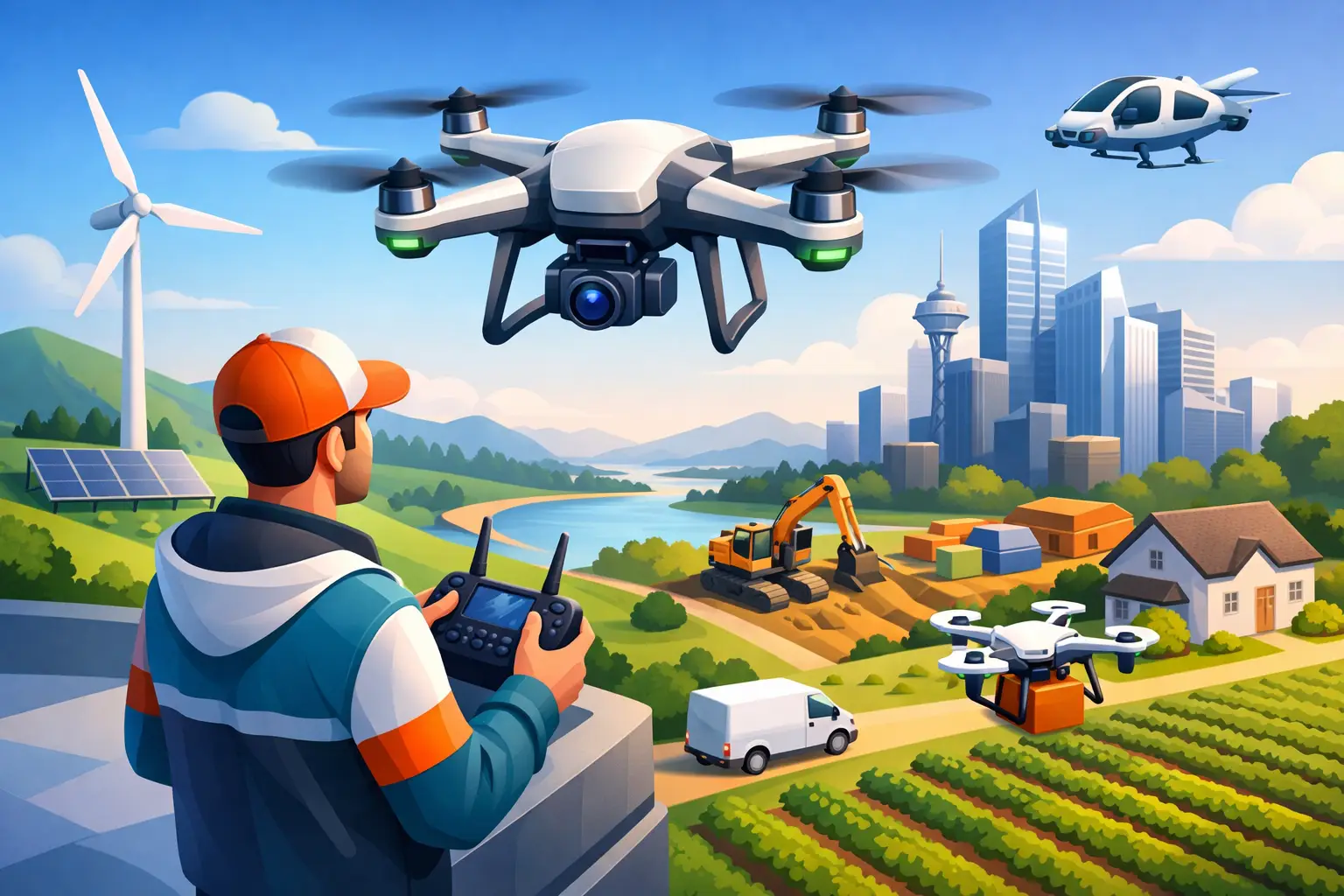
A drone can capture dramatic aerial footage in minutes, but the strongest drone pilot opportunities are rarely built on flying skill alone. Employers and clients pay for usable results: an accurate map, a documented roof condition, a construction progress report, or imagery that helps a public safety team make a faster decision. For people considering an aviation career, that distinction matters. Commercial drone work can be an accessible entry point into aviation, but it is also a technical, regulated profession with very different career paths.
Where Drone Pilot Opportunities Are Growing
The commercial drone market is broad, and job titles do not always say “drone pilot.” You may see openings for UAS pilot, remote pilot, drone operator, sUAS technician, aerial data specialist, survey technician, field inspector, or flight operations coordinator. In many roles, flying is one part of a larger job that includes planning, data collection, equipment management, and client reporting.
Infrastructure inspection is one of the most practical areas to investigate. Utility companies, engineering firms, telecommunications contractors, and renewable energy businesses use drones to inspect power lines, cell towers, solar arrays, wind turbines, bridges, and industrial facilities. The value is clear: drones can reduce the need for personnel to enter hazardous or difficult-to-reach locations. Pilots in this work need disciplined operating habits, strong image capture skills, and the ability to follow detailed site procedures.
Construction and mapping create another significant pathway. Contractors use aerial imagery to document project progress, measure stockpiles, support site planning, and communicate with stakeholders. Surveying and geospatial firms may use drones to collect imagery that is processed into orthomosaics, 3D models, and elevation data. This work can be appealing for pilots who prefer technical projects over media production, although it often requires additional software knowledge and close coordination with licensed surveyors.
Media remains a visible route into drone work, particularly in real estate, tourism, events, marketing, and film production. It can be a good fit for pilots with photography, video editing, or client-service experience. However, it is also highly competitive. A real estate agent may hire a drone photographer occasionally, while an engineering client may need recurring inspection or progress documentation. The difference affects both income stability and the time required to build a client base.
Public safety agencies use drones for search and rescue, crash documentation, fire scene awareness, tactical operations, and disaster assessment. These positions are often filled by existing police, fire, emergency management, or public works personnel rather than outside freelance pilots. For someone interested in public safety aviation, joining the underlying profession may be the more realistic route than applying only for a drone-specific role.
Agriculture, insurance, environmental monitoring, and security also employ drone teams. The common thread is not the aircraft itself. Each field uses the aircraft to solve an operational problem, which is why subject-matter knowledge can raise a pilot’s value substantially.
The FAA Credential That Opens Commercial Work
In the United States, most paid drone operations require an FAA Remote Pilot Certificate under Part 107. This certificate is the starting credential for commercial remote pilots operating small unmanned aircraft systems. It requires passing an FAA knowledge test covering airspace, weather, regulations, aeronautical decision-making, and other operational subjects.
Part 107 is not a complete career qualification. Passing the exam demonstrates baseline regulatory knowledge, but employers may also assess whether you can conduct a site survey, recognize airspace and weather risks, manage a visual observer, brief a crew, and respond appropriately when conditions change. A pilot who understands the rules but cannot run an organized field operation will have limited options.
Some assignments require planning beyond routine Part 107 operations. Flights at night, in controlled airspace, near people, or in complex environments may involve specific rules, equipment requirements, authorizations, or operational limitations. The legal details depend on the mission. Responsible pilots avoid promising a client that a flight is possible until they have reviewed the location, airspace, and operating conditions.
A Part 107 certificate is generally enough to begin commercial work, but other aviation credentials can help in certain settings. A manned-aircraft pilot certificate may strengthen aviation knowledge and credibility, particularly in organizations with mature flight operations. It is not automatically required for drone work, so it should be pursued because it supports your broader career plan, not because it seems like a universal prerequisite.
Build Skills That Make You Employable
Employers look for more than smooth stick inputs. They want a person who can safely produce a deliverable that fits the job. The most useful skill mix depends on the field you choose.
For inspection roles, learn to capture repeatable imagery and identify visible issues without making claims outside your qualifications. A drone pilot may document corrosion, missing shingles, or panel damage, but an engineer, roofer, or inspector may be responsible for the final diagnosis. Knowing that boundary protects both the pilot and the client.
For mapping and survey-adjacent work, become comfortable with mission-planning apps, ground control concepts, photogrammetry, geographic information systems, and data quality checks. You do not need to become a licensed surveyor to work around geospatial data, but you must understand when measurements have legal or engineering significance. State rules and project requirements can determine what work must be performed or supervised by a licensed professional.
For media work, develop a portfolio that shows competent composition, controlled camera movement, color correction, and editing. The flight may last 15 minutes, but the client judges the final product. Pilots who can quote, schedule, fly, edit, deliver, and communicate professionally are more likely to earn repeat business than those selling footage alone.
Across every specialty, strong operational habits matter. Employers notice pilots who maintain batteries properly, keep flight records, inspect equipment, back up files, carry appropriate insurance, and communicate calmly with site managers. Those habits are less glamorous than aerial video, but they are what make a pilot dependable.
Employment, Contracting, or Building a Business
There are three main ways to pursue a drone career: work for an employer, operate as a contractor, or build a drone services business. Each has real trade-offs.
An employee role may offer steadier income, equipment provided by the company, and a clearer training structure. It can be especially attractive in utilities, construction, engineering, public safety, or enterprise drone operations. The downside is that entry-level positions may combine flying with other duties, such as field inspection, data processing, or equipment support. That is not necessarily a negative. Those related responsibilities often create the experience that leads to better-paying work.
Contract positions can provide flexibility and exposure to multiple industries. They also require more self-management. Contractors may need to supply equipment, insurance, transportation, invoicing, and availability on short notice. A contractor without a specialty can find that rates are pressured by hobbyists willing to fly cheaply.
Starting a business gives you the most control, but it should be treated as a sales and operations challenge rather than a flying challenge. Before purchasing premium equipment, identify a local customer segment and the problem you will solve for it. A focused service, such as monthly construction progress imagery or roof documentation for a specific group of contractors, is usually easier to market than general aerial photography.
What Pay Looks Like for Drone Pilots
Drone pilot compensation varies widely because “drone pilot” covers very different work. A freelance real estate shoot may pay a few hundred dollars, but that revenue must cover travel, editing, insurance, taxes, equipment wear, and the time spent finding clients. It should not be compared directly with an hourly employee wage.
Salaried or hourly roles in inspection, mapping, public safety, and enterprise operations can provide more predictable earnings. Pay is influenced by location, travel requirements, technical specialization, industry experience, security clearances, data-processing ability, and whether the role includes supervisory responsibility. A remote pilot who can collect imagery is useful. A pilot who can plan complex missions, manage compliance, process data, and explain results to project leaders is harder to replace.
Be cautious with broad salary claims online. Some figures combine hobbyist side income with full-time technical roles, while others reflect job postings in high-cost markets. When evaluating an opportunity, ask how much flight time is actually involved, what deliverables are expected, whether travel is required, and which costs the employer covers.
A Practical Path Into the Field
Start with Part 107 preparation, then select an industry direction before spending heavily on aircraft. If you are drawn to construction, learn how contractors document projects. If you prefer analytical work, practice mapping workflows and data processing. If media interests you, build a polished portfolio and learn the business side of production.
Next, seek experience that resembles paid work. Volunteer only when the project is legitimate and the scope is clear, but use small assignments to practice client communication, preflight planning, image organization, and delivery standards. Keep a record of missions, equipment used, conditions, and outcomes. This becomes useful evidence of professionalism when applying for jobs.
Finally, position yourself as an aviation professional who understands a client’s industry, not simply as someone who owns a drone. The aircraft may get you into the conversation. Safety judgment, technical skill, and reliable results are what turn that conversation into a career.
Have any thoughts?
Share your reaction or leave a quick response — we’d love to hear what you think!
-
 0
0
-
0
-
0
-
0
-
0
-
0