AVIATION JOBS GUIDE

Space Operations Careers: Mission Control, Payload, and Satellite Operations
Explore Space Operations Careers across mission control, satellite operations, and payload integration. Discover salary trends and defense pathways.
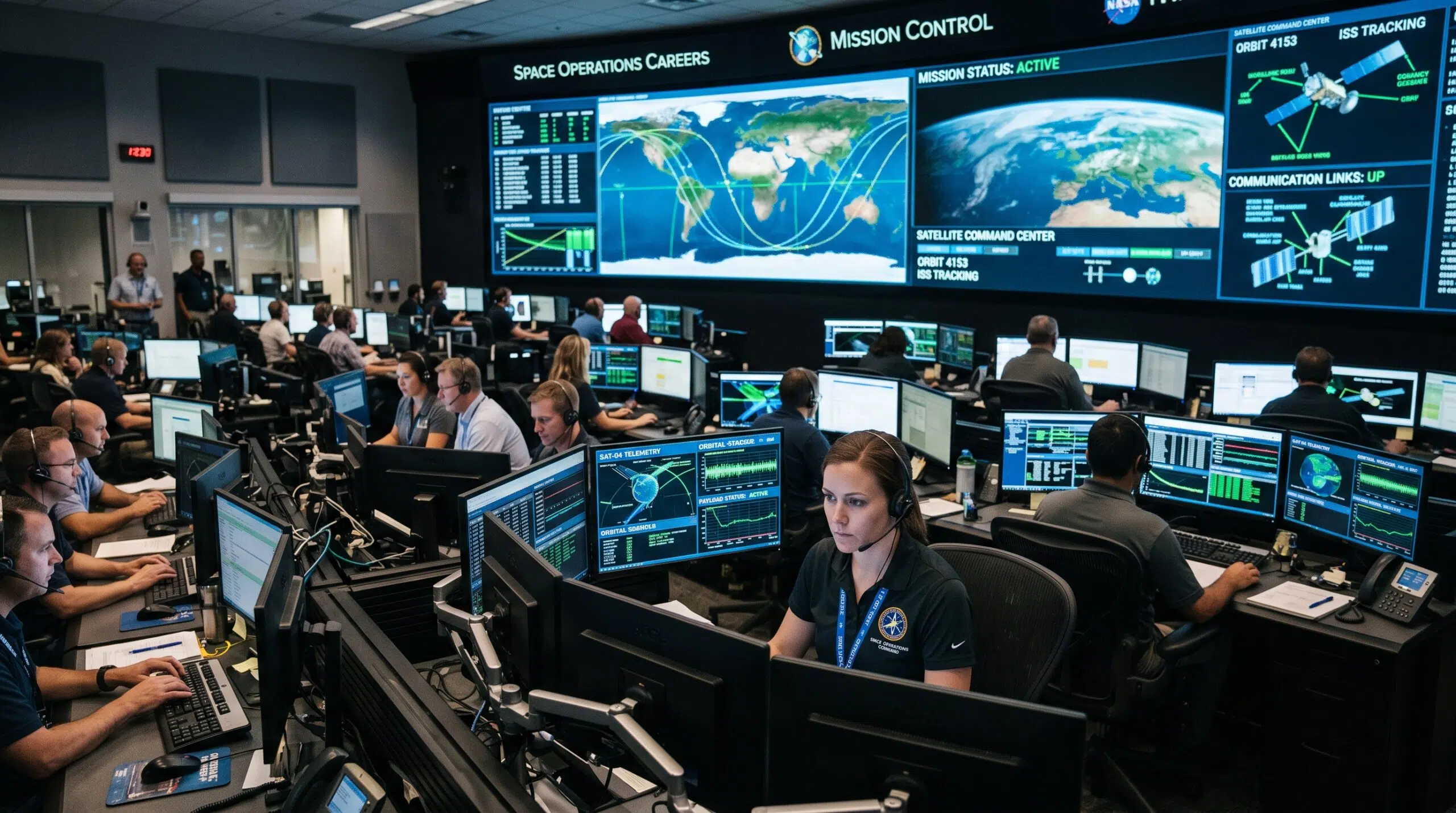
The global space economy has shifted from isolated, government-funded exploration programs to an active operational domain populated by commercial mega-constellations, orbital manufacturing stations, national security architectures, and crewed lunar missions. This expansion has transformed the demand for ground-based personnel. While launch vehicle engineering captures public attention, modern space assets depend continuously on real-time flight controllers, orbital analysts, ground station engineers, and payload specialists.
Space operations careers encompass the technical disciplines required to command, protect, and extract value from space hardware once it leaves the launch pad. Operating in this environment demands technical literacy, operational discipline, and the ability to execute rapid, high-stakes decisions under duress.
Mission Control and Flight Console Roles in Space Operations Careers
Human spaceflight and complex robotic exploration depend on centralized mission control centers (MCCs) designed to monitor telemetry, execute flight plans, and mitigate in-flight anomalies. Console operators work in continuous shift rotations to maintain constant communication and operational oversight.
Primary Flight Controller Consoles in Space Operations Careers
At major installations—such as NASA’s Christopher C. Kraft Jr. Mission Control Center in Houston, the European Space Operations Centre (ESOC) in Darmstadt, and commercial mission centers like SpaceX’s Starbase and Hawthorne control rooms—operations are organized by spacecraft subsystem:
- Flight Director (FLIGHT): Holds ultimate operational authority over vehicle safety, crew life, and mission objectives. The Flight Director leads the console team, resolves competing technical priorities, and makes real-time “go/no-go” execution calls.
- Flight Dynamics and Trajectory (FIDO / TOPO): Manages the physical flight path of the spacecraft. These specialists calculate orbital insertions, orbital trim maneuvers, rendezvous trajectories with the International Space Station (ISS), and reentry burn profiles.
- Environmental and Consumables Life Support Systems (ECLSS): Oversees the internal environment of crewed vehicles. ECLSS controllers monitor cabin pressure, oxygen partial pressure, carbon dioxide scrubbing, trace contaminant control, and thermal loop fluid balances.
- Ground Control (GC) and Communications: Oversees the terrestrial and space-based data networks that connect the spacecraft to the ground. They manage handoffs between the Space Network Tracking and Data Relay Satellite (TDRS) system, ground tracking stations, and the console displays.
- Capsule Communicator (CAPCOM): Traditionally an astronaut, this specialist serves as the single voice communicating directly with the crew in orbit, translating complex technical inputs from subsystem controllers into concise radio communications.
Operations teams utilize a “front room/back room” structure. Front-room controllers communicate directly on the operational voice loops, while back-room specialists (in the Multi-Purpose Support Rooms) perform computational analysis, review anomalous trend data, and prepare detailed procedural recovery steps.
Satellite Command Centers and Constellation Tracking in Space Operations Careers
The shift from single, multi-ton geostationary (GEO) satellites to distributed Low Earth Orbit (LEO) constellations containing thousands of spacecraft has restructured commercial satellite operations. Satellite Command Centers (SCCs) run automated fleet architectures requiring specialized operators.
Fleet Automation and Fleet Flight Dynamics in Space Operations Careers
- Telemetry, Tracking, and Commanding (TT&C): Satellite operators manage radio links to upload stored command sequences, downshift stored health data, and verify system status across distributed ground station networks (such as KSAT, Viasat, and AWS Ground Station).
- Collision Avoidance and Space Traffic Management: Low Earth orbit features an increasingly crowded debris environment. Flight dynamics engineers analyze Conjunction Data Messages (CDMs) from the 18th Space Defense Squadron, compute miss distances, and plan Collision Avoidance Maneuvers (CAMs) to safeguard assets.
- Station-Keeping and Disposal Operations: Operators manage electric and chemical propulsion burns to keep satellites within designated orbital slots. At the end of operational life, they direct controlled deorbit burns or raise spacecraft into designated graveyard orbits in compliance with international orbital debris mitigation standards.
Defense and National Security Pathways in Space Operations Careers
National security space operations represent a substantial and rapidly growing employment sector focused on space domain awareness, tactical satellite communications, and missile warning architectures.
Military Guardians and Defense Contracting in Space Operations Careers
The United States Space Force (USSF) coordinates military operations through Space Operations Command (SpOC). Career paths in this domain fall into two distinct pathways:
- Active-Duty Military Roles: Commissioned Space Operations Officers (13S) and enlisted Space Systems Operations Guardians (5S0) execute missions assigned to operational Deltas. For example, Space Delta 2 monitors space domain awareness, Space Delta 4 operates missile tracking infrared satellites (SBIRS), and Space Delta 8 manages military SATCOM and GPS constellations.
- Defense Mission Integration: Prime aerospace contractors and system integrators—including Lockheed Martin, Northrop Grumman, SAIC, Leidos, and CACI—provide civilian flight controllers and data analysts inside Secure Compartmentalized Information Facilities (SCIFs) supporting the National Reconnaissance Office (NRO) and Space Systems Command.
Commercial Spaceflight and Payload Integration in Space Operations Careers
A successful mission requires translating a customer’s scientific, commercial, or military payload into a physical assembly capable of surviving launch loads, structural vibrations, and space radiation.
Cleanroom Processing and Flight Preparation in Space Operations Careers
Payload processing takes place inside strict environmental cleanrooms (typically ISO 14644 Class 7 or Class 8) at spaceport facilities like Cape Canaveral Space Force Station, Vandenberg Space Force Base, and the Mid-Atlantic Regional Spaceport (MARS):
- Mechanical and Electrical Integration: Payload engineers mate spacecraft to launch vehicle payload attach fittings (PAF) or dispensers. They execute electrical interface verification tests to confirm command, power, and data routing.
- Environmental Testing and Encapsulation: Technicians conduct purge line hookups, functional tests under vacuum or nitrogen blankets, and fairing encapsulation operations.
- Payload Operations Integration: For space station science, operations specialists at facilities like the Payload Operations Integration Center (POIC) at NASA Marshall Space Flight Center coordinate directly with researchers, managing power allocation, rack cooling, and crew intervention timelines.
Professional Pathways and Operational Skills for Space Operations Careers
Unlike pure design engineering disciplines, operations roles demand operational temperament, procedural discipline, and systems-level breadth rather than narrow component specialization.
Training Regimens and Security Clearances for Space Operations Careers
- Academic Foundations: Entry into technical operations typically requires a Bachelor of Science in Aerospace Engineering, Electrical Engineering, Systems Engineering, Computer Science, or Applied Physics.
- Simulation-Based Qualification: Before certifying on a flight console, candidates complete extensive simulation training. “Sim-Sup” (Simulation Supervisor) teams intentionally inject off-nominal telemetry, communication dropouts, and hardware failures to evaluate a candidate’s procedural adherence, stress management, and decision speed.
- Security Clearances: Most defense and government satellite command positions require candidates to obtain and maintain a Top Secret / Sensitive Compartmented Information (TS/SCI) clearance, necessitating thorough background investigations and polygraph examinations.
Compensation Benchmarks and Geographic Hubs for Space Operations Careers
Compensation in space operations reflects specialized skills, shift requirements, and security clearance access.
Salary Outlook and Regional Clusters for Space Operations Careers
| Career Level | Experience | Average Salary Range | Typical Roles and Responsibilities |
| Associate Operator / Controller | 0–2 Years | $70,000 – $88,000 | Ground station telemetry logging, routine passes, script execution |
| Certified Operations Engineer | 3–6 Years | $92,000 – $125,000 | Active console ownership, maneuver planning, anomaly resolution |
| Senior Controller / Flight Lead | 7–10 Years | $130,000 – $160,000 | Front-room lead, contingency execution, payload integration lead |
| Flight Director / Operations Manager | 10+ Years | $165,000 – $215,000+ | Mission authority, team certification, flight rule management |
Geographic distribution is concentrated around key operational command infrastructure:
- Houston, Texas: Centered around NASA Johnson Space Center and growing commercial space ventures (Axiom Space, Intuitive Machines) supporting human flight and lunar surface payloads.
- Colorado Springs and Denver, Colorado: The premier national defense space hub, hosting Peterson Space Force Base, Schriever Space Force Base, Buckley Space Force Base, and associated aerospace contractors.
- Los Angeles and El Segundo, California: Home to Space Systems Command, The Aerospace Corporation, and SpaceX headquarters.
- Brevard County, Florida: The Space Coast cluster driving high-tempo launch processing, payload cleanroom encapsulation, and range operations.
- Northern Virginia and Washington D.C.: The intelligence and defense operations center overseeing orbital intelligence collection, national satellite command architecture, and policy coordination.
As orbital infrastructures become vital to global commerce, telecommunications, and defense, space operations specialists remain the frontline stewards keeping these multi-million-dollar platforms operational, secure, and productive.


