AVIATION JOBS GUIDE
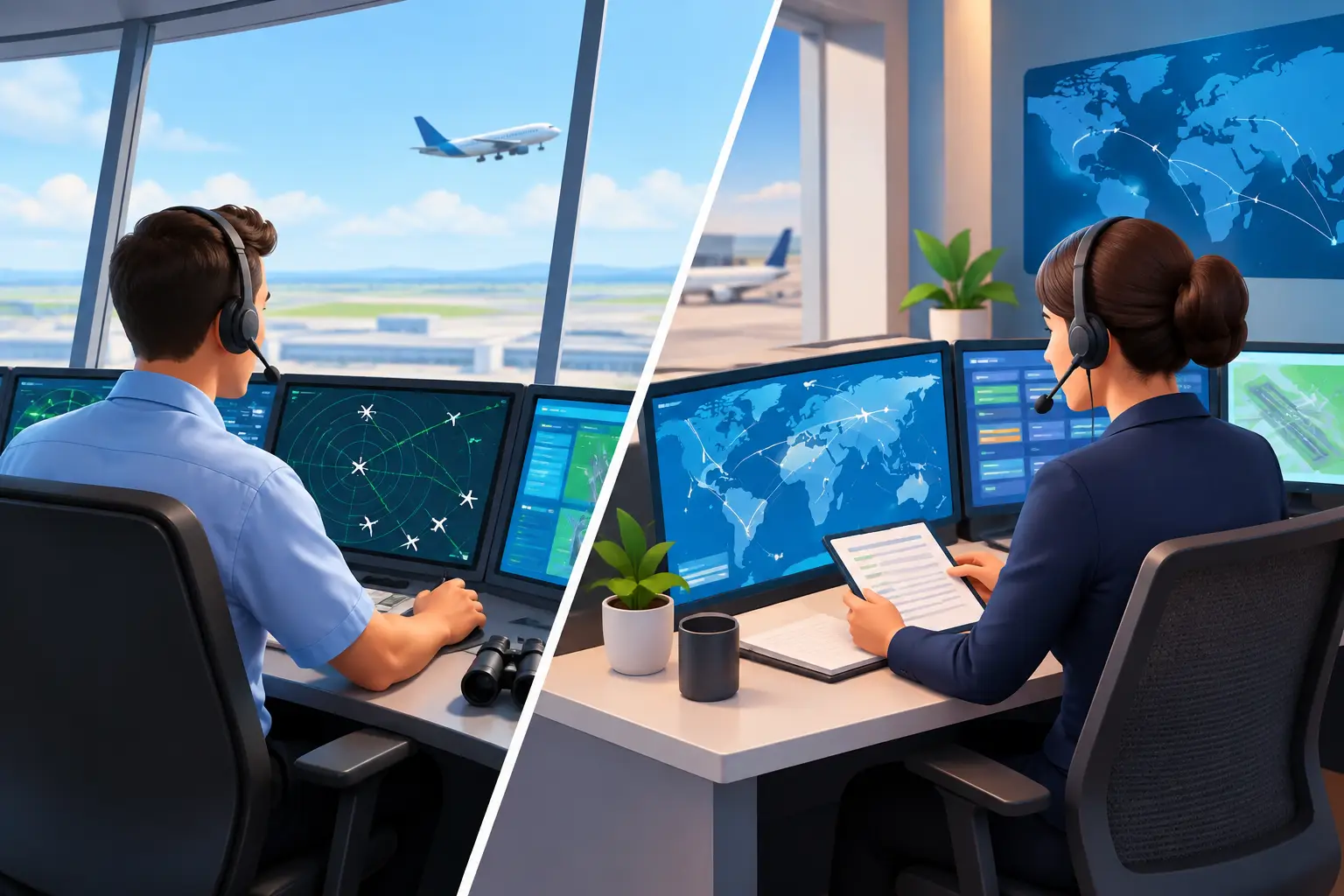
Air Traffic Controller Versus Dispatcher Jobs
Compare air traffic controller versus dispatcher careers, including duties, training, schedules, pay, stress, and the path that fits your goals best.
A delayed flight is rarely caused by one person. A controller may be managing a crowded arrival bank and spacing aircraft through weather, while a dispatcher is recalculating fuel, rerouting a flight around storms, and coordinating with the captain. Both jobs keep aviation moving safely, but the air traffic controller versus dispatcher decision comes down to where you want to sit in the operation, how you handle pressure, and which training path suits you.
For career changers and students, the two roles can look similar from a distance. Both require technical judgment, round-the-clock operations, strict procedures, and calm communication. Their day-to-day responsibilities, federal requirements, earnings structure, and work environments are very different.
Air Traffic Controller Versus Dispatcher: The Core Difference
An air traffic controller directs the safe and efficient movement of aircraft in controlled airspace and on airport surfaces. Depending on the facility, a controller may issue taxi instructions from an airport tower, sequence departures and arrivals at a radar approach control, or manage traffic across large sections of high-altitude airspace at an en route center.
A flight dispatcher, commonly called an aircraft dispatcher, works for an airline or other qualifying operator from an operations control center. Dispatchers plan flights before departure, evaluate weather and operational risks, calculate fuel needs, select routes and alternates, monitor flights in progress, and communicate with flight crews. For airline operations conducted under FAA Part 121 rules, the dispatcher shares operational control with the pilot in command.
That shared authority is a defining distinction. A dispatcher does not tell an aircraft how to fly in the airspace system or issue control clearances. A controller does not build the airline’s flight release or decide whether a specific flight should carry additional contingency fuel. The jobs meet at the same operational goal, but each professional owns a different part of it.
What the Work Feels Like
Air traffic control is immediate and highly tactical. Controllers make rapid decisions based on live radar displays, radio calls, airport activity, aircraft performance, weather, and separation standards. At a busy facility, the workload can change within minutes. A controller must prioritize accurately, communicate with precision, and remain focused even when the traffic picture becomes complex.
Dispatch is also time-sensitive, but it is more planning-intensive and broader in scope. One dispatcher may oversee several flights at once, tracking weather systems, airport restrictions, maintenance issues, crew or passenger considerations, and changing airspace conditions. When disruptions occur, dispatchers help create practical solutions that protect safety while supporting the airline schedule.
Neither role is an easier version of the other. Controllers generally face more moment-to-moment, real-time separation responsibility. Dispatchers often manage a wider operational puzzle over a longer time horizon. People who enjoy quick decisions and direct radio communication may lean toward ATC. Those who enjoy weather analysis, flight planning, coordination, and solving operational problems may find dispatch more satisfying.
Training and Entry Requirements
The entry paths are not interchangeable. Air traffic controllers working for the Federal Aviation Administration are federal employees, and FAA hiring standards are specific. Applicants typically must be U.S. citizens, meet age requirements that generally require appointment before age 31, pass medical and security evaluations, and qualify through an approved hiring pathway. They must also complete assessments and, if selected, progress through FAA Academy and facility-specific training.
Aviation experience can help, but a college degree is not the only route. Candidates may qualify through combinations of education, work experience, military air traffic control experience, or other FAA-recognized pathways. Collegiate Training Initiative programs can provide relevant preparation, although completing one does not guarantee an FAA job offer. The selection process is competitive, and academy acceptance is only the beginning. New controllers must successfully certify at their assigned facility.
Dispatch has a more direct civilian certification route. To become an FAA-certificated aircraft dispatcher, you generally must be at least 23 years old when the certificate is issued, be able to read, speak, write, and understand English, complete required training or gain qualifying experience, and pass FAA knowledge and practical tests. Many candidates attend an FAA-approved dispatcher certification course, often completed in several intensive weeks.
The dispatcher curriculum covers subjects such as aviation weather, navigation, regulations, aircraft performance, flight planning, emergency procedures, and decision-making. The certificate creates access to airline dispatch roles, but employers still train new hires on their fleet, systems, routes, and operating procedures.
For someone seeking a predictable training timeline, dispatch is usually the faster entry option. ATC can offer exceptional long-term rewards, but its hiring process and training timeline are less predictable and more dependent on FAA staffing needs and successful progression through training.
Schedule, Work Setting, and Lifestyle
Both careers involve shift work. Aviation operates overnight, on weekends, and during holidays, so neither path is ideal for someone who needs a standard Monday-through-Friday schedule from the start.
Controllers work in towers, approach control facilities, or en route centers. Their shifts include required breaks because sustained concentration is central to safety. Facility location matters greatly. An assignment may place a new controller far from home, and moving to a preferred location can take time. Work is typically performed in a secure, structured environment with limited flexibility for remote work.
Dispatchers usually work in airline operations centers, often near a carrier’s headquarters or a major hub. The work is desk-based but far from passive. During a major weather event, a dispatcher may be making calls, revising releases, coordinating with crews, and communicating across several departments. Some airline operations roles may offer more geographic stability than ATC, but schedules can still include nights, weekends, and holidays.
Lifestyle preference can be a deciding factor. If you want a role centered on a single live traffic position, ATC may fit. If you prefer overseeing multiple flights and working closely with airline operations, dispatch may be a better match.
Pay and Advancement Potential
Air traffic control usually has the higher earning ceiling, particularly after full certification at a busy FAA facility. Compensation includes a federal pay structure with locality adjustments, premiums, and other factors that can vary by facility and schedule. Experienced controllers commonly earn well into six figures, although trainees earn considerably less while progressing through academy and facility training.
The trade-off is that higher pay comes with a demanding selection process, intense training, and little control over initial facility assignment. Not every candidate who begins the pipeline completes it, so prospective controllers should view the path as competitive rather than guaranteed.
Dispatcher pay varies more by airline, union agreement, location, seniority, and the scope of the operation. Entry-level dispatch positions may start at a more modest level than controller trainee pay, while experienced dispatchers at major airlines can earn strong salaries, especially with shift differentials, overtime, and contractual pay increases. The career can also lead to management, operational leadership, flight operations analysis, and related airline roles.
When comparing compensation, look beyond a starting number. Consider the cost and length of training, retirement benefits, scheduling, overtime expectations, relocation risk, and how quickly pay rises after initial qualification. A high salary is meaningful only if the work pattern and pressure level are sustainable for you.
Stress: Similar Stakes, Different Pressure
Both roles are safety-sensitive, and both require disciplined procedures. The difference is how pressure arrives.
For controllers, pressure often comes in compressed bursts. A runway change, weather deviation, equipment issue, or surge of traffic can require immediate action. Strong spatial awareness, working memory, and concise communication are essential.
For dispatchers, pressure can build across an entire operation. A line of thunderstorms, airport closure, aircraft maintenance delay, or crew issue may affect many flights and passengers. The dispatcher must balance safety, regulatory compliance, fuel, aircraft capability, and airline operations without losing sight of the crew’s real-world conditions.
If stress causes you to freeze, neither role is a casual fit. If you can use procedures, training, and teamwork to stay organized under pressure, both can be deeply rewarding aviation careers.
Which Career Should You Choose?
Choose air traffic control if you want direct responsibility for aircraft separation, thrive on rapid tactical decisions, and are prepared for a competitive federal hiring and training process. It is especially appealing to people who enjoy active communication, spatial problem-solving, and a defined public-service career structure.
Choose dispatch if you want to influence flight safety and reliability through planning, weather analysis, and airline coordination. It can be a strong option for candidates who want a faster certification path, prefer a flight operations center to a control facility, and enjoy understanding the full operational picture behind every departure.
Before committing, compare the actual hiring requirements for the roles available now, not just the job descriptions. Attend a dispatcher course information session, speak with professionals when possible, and honestly assess how you respond to shift work, high-stakes decisions, and structured training. The best path is the one that matches how you think and work when aviation gets complicated.