Newsletter Subscribe
Enter your email address below and subscribe to our newsletter
AVIATION JOBS GUIDE

Aerospace engineering careers attract people who are fascinated by flight, space exploration, advanced technology, and solving complex engineering challenges.
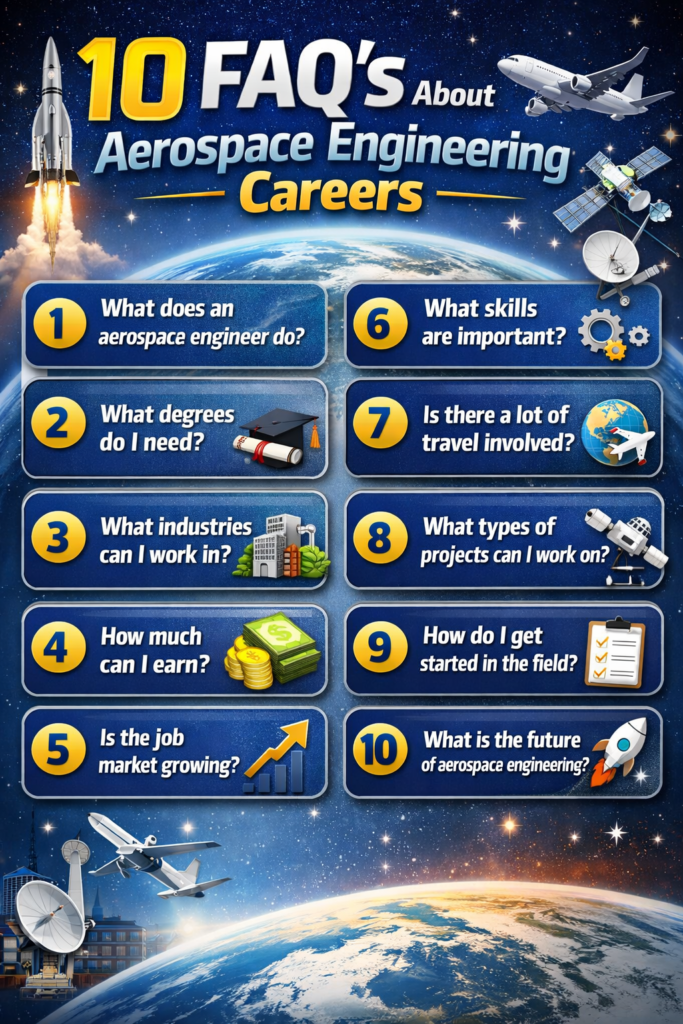
Aerospace engineering careers attract people who are fascinated by flight, space exploration, advanced technology, and solving complex engineering challenges. Whether designing next‑generation aircraft, developing spacecraft propulsion systems, or improving satellite communications, aerospace engineers play a critical role in shaping the future of aviation and space. Below is a comprehensive, SEO‑optimized guide that answers the most common questions about aerospace engineering careers, degrees, skills, salaries, and job outlook.
Aerospace engineers design, test, analyze, and improve systems that operate in the atmosphere and outer space. Their work includes aircraft, spacecraft, satellites, missiles, drones, and propulsion systems. Day‑to‑day responsibilities vary by specialty but often include:
Aerospace engineering careers span aerodynamics, avionics, materials science, propulsion, systems engineering, and more. These engineers solve high‑stakes problems related to performance, safety, efficiency, and sustainability—making their work essential to modern aviation and space exploration.
Most aerospace engineers begin with a bachelor’s degree in aerospace engineering. However, degrees in mechanical engineering, electrical engineering, or materials engineering can also lead to aerospace engineering jobs, especially with relevant coursework or project experience.
Many professionals pursue a master’s degree to specialize in areas such as:
Hands‑on experience is extremely valuable. Internships, co‑ops, undergraduate research, and participation in engineering clubs (like rocketry teams or UAV design teams) significantly improve job prospects.
Aerospace engineering is considered one of the more challenging engineering disciplines because it requires strong foundations in physics, advanced mathematics, materials science, and systems thinking. Students must understand how complex systems behave under extreme conditions, such as high speeds, high temperatures, and low atmospheric pressure.
However, for people who enjoy problem‑solving, technology, and hands‑on engineering, the challenge is part of the appeal. The difficulty is balanced by:
Aerospace engineering careers extend far beyond airplanes and rockets. Aerospace engineers work in a wide range of industries, including:
The field is diverse, and aerospace engineers are needed anywhere advanced flight systems or high‑performance technologies are developed.
Aerospace engineering salaries are highly competitive. While pay varies by experience, industry, and location, typical ranges include:
Engineers working in defense, space systems, or advanced R&D often earn on the higher end of the spectrum. Aerospace engineering careers consistently rank among the highest‑paid engineering fields.
Successful aerospace engineers combine technical expertise with strong analytical and communication skills. Key abilities include:
Soft skills matter just as much as technical skills, especially for leadership or systems‑level roles.
Aerospace engineering includes several major specialties, each leading to different career paths:
These specialties allow engineers to tailor their careers to their interests, whether that’s designing rockets, optimizing aircraft wings, or developing autonomous drones.
Not at all. While NASA and SpaceX are well‑known employers, most aerospace engineers work in:
The aerospace industry is broad, global, and expanding rapidly.
Yes. Aerospace engineers are highly versatile because they are trained in systems thinking, advanced analysis, and multidisciplinary engineering. They often transition into:
Their problem‑solving skills are valued across many industries.
The job outlook for aerospace engineering careers is strong. Growth is driven by:
Engineers with expertise in systems engineering, autonomy, propulsion, and advanced materials are especially in demand.