Newsletter Subscribe
Enter your email address below and subscribe to our newsletter
AVIATION JOBS GUIDE

Aerospace engineers play a critical role in designing, developing, and improving the aircraft, spacecraft, and advanced flight systems that shape modern aviation and space exploration.
An Aerospace Engineers’ career plays a defining role in shaping the technologies that power modern aviation and space exploration. As global demand increases for faster, safer, and more sustainable flight, aerospace engineers are stepping into more influential positions across commercial aviation, defense, space missions, and emerging advanced air mobility sectors. Whether developing next‑generation aircraft, designing reusable rockets, or advancing electric propulsion systems, aerospace engineers remain at the forefront of innovation in one of the world’s most technologically advanced industries.
This comprehensive guide explores the major career paths, specializations, and opportunities available to aerospace engineers today, along with how the field continues to evolve.
An Aerospace Engineers’ career centers on the design, development, testing, and improvement of aircraft, spacecraft, satellites, drones, and advanced flight systems. Aerospace engineers apply principles of physics, mathematics, materials science, and computer modeling to solve complex challenges related to aerodynamics, propulsion, structural integrity, and flight safety.
As technology advances, aerospace engineers increasingly contribute to:
Because the aerospace industry continues to expand, engineers now have more diverse and specialized career options than ever before.

Aircraft Design and Development: A Core Aerospace Career Path
One of the most established and foundational directions in an Aerospace Engineers’ career is aircraft design and development. Engineers in this area contribute to the creation and improvement of commercial airliners, military jets, helicopters, and business aircraft.
Aerospace engineers often focus on one or more technical domains within aircraft development:
Aerodynamics specialists analyze airflow around aircraft surfaces, reduce drag, and optimize lift to improve performance and fuel efficiency.
Structural engineers ensure that aircraft components can withstand extreme forces, vibrations, and environmental conditions while maintaining safety and reliability.
Propulsion engineers design and refine engines, including turbofan, turboprop, and emerging electric propulsion systems that support sustainable aviation.
These engineers develop the systems that allow pilots or autonomous systems to control aircraft safely and precisely, integrating sensors, software, and mechanical components.
Aircraft design roles are ideal for aerospace engineers who want to work directly on the systems that keep aircraft flying reliably and efficiently. These positions involve extensive simulation work, collaboration with multidisciplinary teams, and rigorous testing to meet strict safety and regulatory standards.
Another major direction in an Aerospace Engineers’ career is spacecraft and launch vehicle engineering. With the rapid growth of commercial space companies, opportunities in this sector have expanded far beyond traditional government agencies.
Aerospace engineers in this field work on satellites, space probes, crewed spacecraft, reusable rockets, lunar landers, and Mars exploration vehicles. They contribute to missions that push the boundaries of human knowledge and technological capability.
Engineers calculate trajectories, orbital transfers, and mission paths for satellites and spacecraft, ensuring precise navigation in space.
Thermal engineers design heat shields and insulation to protect spacecraft during atmospheric entry or exposure to extreme temperatures.
Propulsion specialists develop chemical, electric, and hybrid propulsion systems that power spacecraft through orbit and deep space.
GNC engineers ensure spacecraft can orient, maneuver, and navigate with accuracy, using advanced algorithms and sensor systems.
As space missions become more frequent and ambitious—driven by lunar exploration, Mars initiatives, and commercial satellite networks—the demand for aerospace engineers with space expertise continues to rise. The expansion of private space companies has opened new opportunities for engineers to work on cutting‑edge missions once limited to government agencies.
The next frontier in an Aerospace Engineers’ career lies in emerging aviation technologies. These rapidly growing sectors blend aerospace engineering with robotics, artificial intelligence, and advanced materials science.
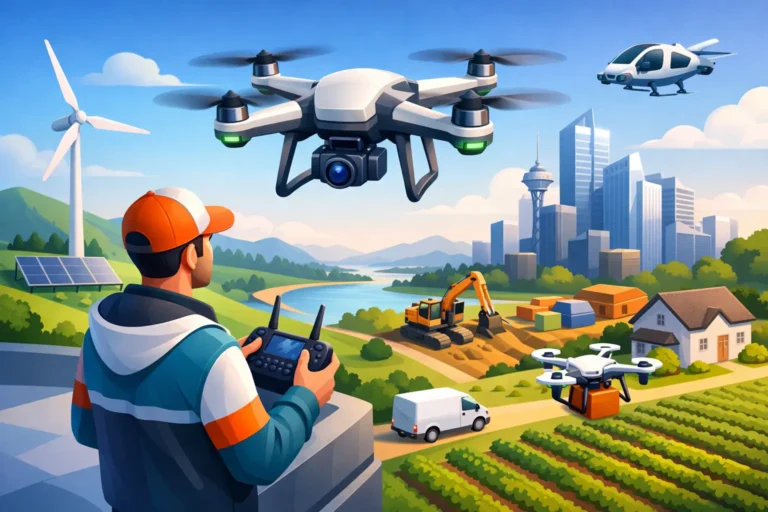
Engineers design drones used in defense, delivery, agriculture, environmental monitoring, and infrastructure inspection.
These aircraft are central to the future of urban air mobility, offering sustainable and efficient transportation solutions.
Aerospace engineers develop systems that enable aircraft to fly with minimal or no human intervention, integrating advanced sensors, machine learning, and real‑time data processing.
Engineers in these sectors often work on:
This area offers some of the fastest‑growing aerospace engineering jobs, especially as cities and companies invest in cleaner, more efficient transportation systems.
Beyond design roles, an Aerospace Engineers’ career can evolve into several specialized technical and operational paths.
Systems engineers coordinate the integration of mechanical, electrical, and software components, ensuring that all subsystems work together seamlessly.
R&D engineers explore new materials, propulsion concepts, aerodynamic technologies, and manufacturing methods that may define the future of flight.
Test engineers validate performance through simulations, wind tunnel experiments, lab testing, and full‑scale flight tests.
Manufacturing engineers focus on production efficiency, quality control, and advanced fabrication techniques such as additive manufacturing.
One of the strengths of an Aerospace Engineers’ career is its versatility. Aerospace engineers often transition into roles such as:
Their analytical skills, problem‑solving abilities, and technical expertise make them valuable across many industries.
From designing commercial aircraft to building spacecraft for interplanetary missions, an Aerospace Engineers’ career offers endless opportunities to innovate and shape the future of flight. As global aviation evolves and space exploration accelerates, aerospace engineers will continue to play a critical role in advancing technology, improving safety, and pushing the boundaries of what is possible.