Newsletter Subscribe
Enter your email address below and subscribe to our newsletter
AVIATION JOBS GUIDE

The comparison of Flight Dispatcher vs. Air Traffic Controller is one of the most important distinctions for anyone exploring aviation careers. These two roles sit at the center of aviation safety, each responsible for a different layer of decision‑making that keeps the system running. Both require calm judgment, technical skill, and the ability to make high‑stakes decisions under pressure. Yet the missions, environments, and daily responsibilities are fundamentally different.
This guide breaks down those differences with clarity and depth so readers can choose the path that fits their temperament, strengths, and long‑term goals.
A flight dispatcher is responsible for planning, releasing, and monitoring flights on behalf of an airline. In the United States, dispatchers share joint legal responsibility with the pilot in command. This means the dispatcher is accountable for the flight’s safety from the moment it is planned until it lands.
Dispatchers work inside an airline operations center, using weather systems, performance tools, NOTAMs, and real‑time data to make strategic decisions. They think in terms of fuel, payload, alternates, routing, and schedule integrity. Their job is to anticipate problems before they occur and build a safe, efficient plan that the flight crew can execute.
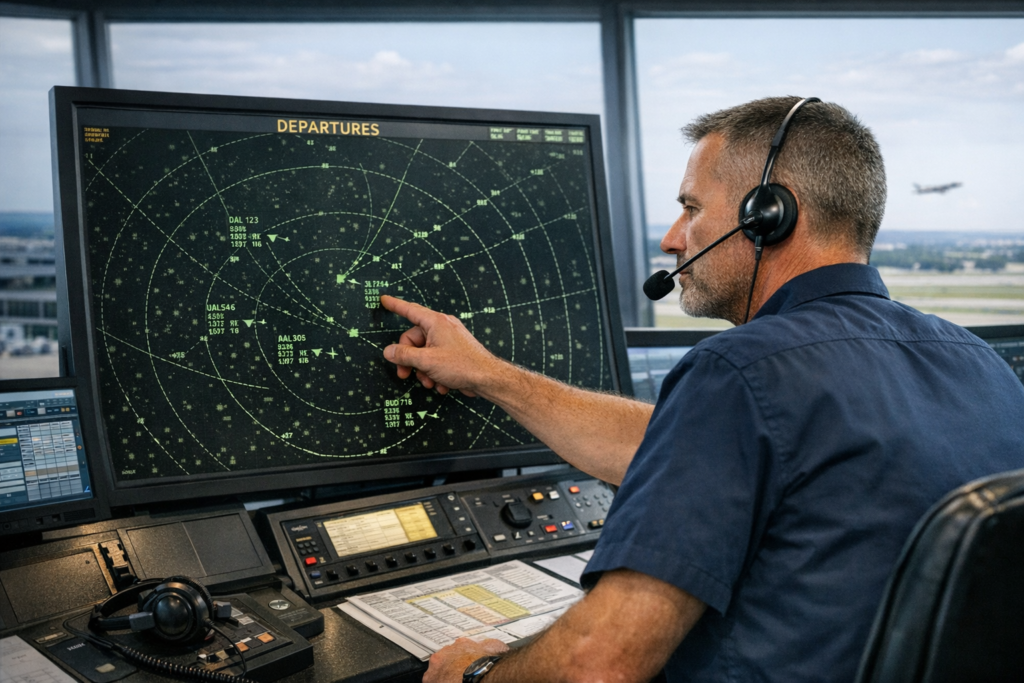
Air traffic controllers manage the safe and orderly flow of aircraft through the national airspace system. They work in towers, TRACON facilities, and en‑route centers. Their mission is separation, sequencing, and communication. Controllers issue clearances, monitor radar, and ensure aircraft maintain safe distances from each other.
Where dispatchers think hours ahead, controllers think in seconds. Their world is tactical, immediate, and unforgiving of hesitation.
The dispatcher’s mission is strategic and system‑wide. Their authority includes:
Dispatchers operate under 14 CFR Part 121 Subpart U, which defines their certification and responsibilities. They are the airline’s operational control backbone.
Controllers operate under FAA Order JO 7110.65 and are responsible for:
Their authority is tactical and immediate—focused on what is happening right now in the airspace.
Dispatchers work in airline operations centers—dimly lit, high‑tech rooms filled with screens, weather displays, and communication systems. The pace is steady and analytical. A dispatcher may oversee 10–25 flights at once, each at different stages of the journey.
Their daily rhythm includes:
It is a blend of meteorology, systems thinking, and crisis management.
Find a flight dispatch job today!
Controllers work in:
The environment is intense, structured, and highly focused. Controllers manage one sector or runway at a time. Their decisions must be immediate, precise, and unambiguous.
Where dispatchers think strategically, controllers think tactically.
The dispatcher mindset is:
Key skills include:
Dispatchers must see the entire system—fleet, weather, airports, constraints—and make decisions that optimize safety and efficiency.
Controllers must be:
Their skills include:
Controllers must process information instantly and issue instructions with absolute clarity.
To become a dispatcher, candidates complete:
Training emphasizes weather, regulations, performance, and operational control. Many dispatchers advance to:
Controllers enter through:
Training includes radar, tower operations, phraseology, and simulation. Controllers progress through:
The path is structured, competitive, and highly regulated.
Dispatcher stress is strategic. It comes from:
The dispatcher must remain calm and analytical—especially during major weather events.
Controller stress is tactical. It comes from:
Controllers must maintain absolute focus for long periods, with mandatory breaks to prevent fatigue.
Dispatchers typically earn:
Lifestyle:
Controllers earn:
Lifestyle:
| Category | Flight Dispatcher | Air Traffic Controller |
|---|---|---|
| Mission | Operational control | Airspace separation |
| Focus | Strategy | Tactics |
| Environment | Operations center | Tower/TRACON/Center |
| Pace | Minutes to hours | Seconds |
| Authority | Joint responsibility with PIC | Tactical control of aircraft |
| Training | ADX + practical | FAA Academy/CTI |
| Salary | $45k–$140k | $50k–$180k |
| Stress Type | Strategic | Immediate |
The comparison of Flight Dispatcher vs. Air Traffic Controller reveals two distinct but interconnected professions. One manages the flight from the ground with strategic foresight. The other manages the airspace with tactical precision. Both careers demand discipline, professionalism, and a commitment to safety.
For anyone exploring aviation careers, understanding this distinction helps clarify identity, temperament, and long‑term fit—ensuring the path chosen aligns with who the student truly is.