AVIATION JOBS GUIDE

Airline Pilot vs Corporate Pilot: 5 Crucial Truths That Could Shape Your Future For the Better

Airline Pilot vs Corporate Pilot: Which is the right path for you?
Choosing a career path in aviation is no longer as simple as “getting to the majors.” In 2026, the industry has shifted. With legacy airline pay reaching historic highs and corporate flight departments offering unprecedented flexibility and tech-forward environments, the debate of Airline Pilot vs Corporate Pilot is more nuanced than ever.
For professional pilots, this decision isn’t just about the airplane you fly; it’s about the “rhythm” of the life you live behind the controls. Whether you are building time at a regional or managing a flight department, here is the 2026 breakdown of lifestyle, pay, and operational reality.
1. The Financial Landscape: Pay, Retirement, and “Soft” Money
In today’s market, compensation is the primary driver of the Airline Pilot vs Corporate Pilot comparison. However, the way you get paid is just as important as the number on your W-2.
The Airline Model (Part 121)
Airline pay is built on the “modular” package. You are paid by the flight hour with a monthly guarantee (typically 72–85 hours).
- The Ceiling: Senior widebody Captains at legacy carriers (Delta, United, American, UPS) are now seeing total compensation packages—including profit sharing—exceeding $500,000.
- The Retirement King: The real “hidden wealth” in 121 operations is the non-elective 401(k) contribution. Many majors contribute 16% of your gross pay regardless of whether you contribute a dime. For a high-earner, that’s an additional $70,000+ in tax-deferred wealth annually.
The Corporate Model (Part 91/135)
Corporate and Charter pilots typically operate on a set annual salary, which offers more “paycheck stability” but often a lower absolute ceiling.
- The Ranges: A Captain on a mid-size jet like a Citation Latitude typically earns $160,000–$210,000, while a long-range heavy jet Captain (Gulfstream G700/Global 7500) can command $300,000–$375,000.
- Soft Compensation: Corporate pilots often keep all their hotel points, rental car rewards, and frequent flyer miles. For a pilot flying 400 hours a year, these “perks” can fund luxury family vacations that would otherwise cost tens of thousands of dollars.
2. Lifestyle and the “Rhythm” of the Road
The “rhythm” of your life is the most significant differentiator. It’s the difference between being a “Line Holder” and being “On-Call.”
The Airline Rhythm: Predictability and Anonymity
Airline pilots bid for their schedules monthly based on seniority. Once you have your “line,” you know exactly where you will be for the next 30 days.
- Pros: When you click the parking brake at the end of a trip, you are truly off. There is no “calling the pilot” to see if they can work on a Tuesday.
- Cons: You are a seniority number. If the airline needs you to fly to Newark on Christmas and your seniority doesn’t allow you to bid off, you’re going to Newark.
The Corporate Rhythm: Flexibility and Relationship
Corporate aviation is on-demand. The schedule is driven by the business needs of the principal or the aircraft owner.
- Pros: You often fly into unique, “bucket-list” destinations (think mountain strips or private islands) that airlines can’t touch. You develop personal relationships with your passengers and enjoy a “small team” atmosphere.
- Cons: You are often “tethered” to your phone. Plans can change in an hour, and “airport appreciation time” (sitting in FBO lounges waiting for passengers) is a significant part of the job.
3. Operational Variety: Bus Driver vs. Limo Driver
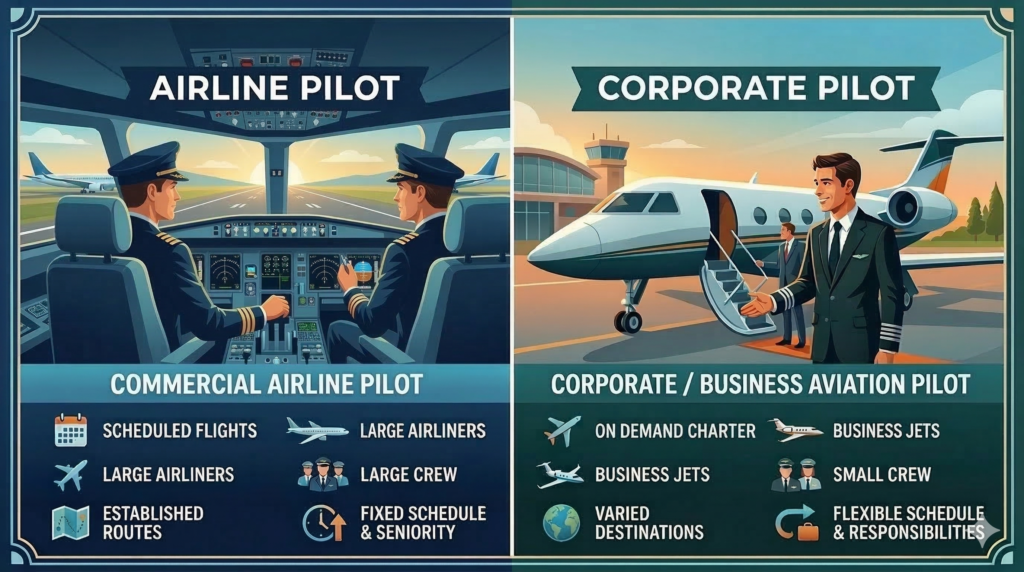
The day-to-day work of an Airline Pilot vs Corporate Pilot requires a different set of professional muscles.
| Feature | Airline Pilot (Part 121) | Corporate Pilot (Part 91/135) |
| Operational Control | Shared with a Dispatcher. | Primarily the Captain’s responsibility. |
| Support Staff | Large teams for gate, fuel, and bags. | You are the ground crew, concierge, and caterer. |
| Security | TSA and Known Crewmember (KCM). | Drive your car straight to the hangar. |
| Flight Planning | Standardized routes and “canned” plans. | High variety; you often plan the international handling. |
In the 121 world, you are a master of SOPs and high-tempo terminal environments. In the corporate world, you are a “Swiss Army Knife” pilot—handling everything from weather briefings to ensuring the passenger’s favorite vintage of wine is on board.
4. Career Progression: Seniority vs. Reputation
In 2026, the “ladder” is moving faster than ever, but the rules of the climb are different for each path.
The Seniority System (Airlines)
Seniority is your only currency. It determines your pay, your aircraft, your seat, and your job security. If you leave one airline for another, you start at the bottom of the list. This makes mid-career moves extremely “expensive” in terms of quality of life.
The Networking System (Corporate)
In corporate aviation, your reputation is your seniority. A pilot with a deep network and multiple type ratings can move between flight departments or move into high-level management (Director of Operations or Chief Pilot) without “losing” their career progress. If a flight department closes, a well-connected pilot can often land a similar or better role within weeks.
5. Decision Matrix: Which Path is Yours?
As you weigh the Airline Pilot vs Corporate Pilot options, ask yourself these three questions:
- Do I want to be a “Service Professional” or a “Technical Professional”? If you enjoy the concierge aspect of private travel, choose Corporate. If you want to focus solely on the “machine” and the SOPs, choose the Airlines.
- How much do I value my “Off” time? If you need total disconnection when you aren’t flying, the Airlines win. If you prefer the flexibility of potentially working less total days in exchange for being “on-call,” Corporate is for you.
- What is my long-term financial goal? If you are chasing a $10M+ lifetime career value and a massive pension/401(k), the Legacy Airlines are hard to beat. If you want a high quality of life now and enjoy “living large” on the road, Corporate offers immediate rewards.
Conclusion
The 2026 aviation industry is a “pilot’s market.” Whether you choose the structured, high-earning path of the Airline Pilot or the high-service, destination-rich life of the Corporate Pilot, the opportunities for professional growth have never been better.
Choose the lifestyle you want to live, and the right flight deck will follow.