Entry-Level A&P Salary Standards in the US
For decades, the standard path into a lifelong career in aviation focused almost entirely on the left seat of a cockpit. However, the unsung heroes of safety and operational readiness are the technicians turning those wrenches on the hangar floor. Today, an unprecedented nationwide shortage of skilled aviation maintenance technicians (AMTs) has thrown a spotlight on the entire career field, making the financial return on investment an essential topic for anyone considering an airframe and powerplant license. If you are exploring this career path, understanding the reality of an entry-level A&P salary is the first step toward mapping out your professional and financial future.
The aviation industry operates on a foundation of precision, and that extends directly to compensation structures. While senior mechanics at major airlines or large corporate flight departments command impressive wages, those fresh out of an FAA-certified Part 147 school must navigate an entry-level landscape that varies significantly by industry sector, geography, and specific operations. A realistic look at the baseline compensation reveals a starting point that provides a solid, living wage with rapid growth potential.
Breaking Down the Initial Compensation Numbers for A&P Mechanic Salary
According to recent labor market reports and aviation maintenance industry data, a newly certified mechanic stepping onto the floor can expect a entrylevel aircraft mechanic salary ranging from $22 to $28 per hour. When translated into an annual figure, a typical entry-level A&P salary starts between $45,000 and $58,000 per year before overtime or shift premiums are factored in.
While that Entry-Level A&P Salary might seem modest compared to top-tier airline captain salaries, the initial training investment required to earn an A&P certificate is significantly lower—and much faster—than a commercial pilot pathway. This means a technician can enter the workforce with minimal student debt and begin earning a real paycheck much sooner.
Furthermore, this baseline figure does not remain stagnant for long. In aviation maintenance, compensation increases are heavily tied to experience, additional certificates (such as an Inspection Authorization), and industry seniority. The Entry-Level A&P Salary represents a temporary floor rather than a long-term earning ceiling. Within three to five years, many technicians see their income climb into the mid-$70,000 range as they master specific airframes and avionics systems.
How Industry Sectors Affect Entry-Level A&P Salary
Not all hangars are created equal, and the type of company you choose to work for will directly dictate your initial earning potential. The aviation industry is broadly divided into general aviation, regional airlines, major commercial air carriers, cargo operations, and maintenance, repair, and overhaul (MRO) facilities.
General Aviation and FBOs
For many new mechanics, general aviation (GA) shops and Fixed-Base Operations (FBOs) offer an attractive starting point. Working on piston-powered single-engine aircraft like Cessnas and Pipers provides unparalleled hands-on experience across multiple systems. However, GA operations typically offer a lower initial entry-level AP mechanic salary compared to commercial operations. Starting pay here often hovers near the lower end of the spectrum, around $45,000 to $50,000 annually. The tradeoff is a predictable daytime schedule and an excellent learning environment.
MRO Facilities and Regional Airlines
Repair stations and regional carriers serve as the bridge to high-capacity operations. Because these facilities handle high volumes of turboprop and regional jet maintenance, they are highly competitive recruiters. A technician accepting a position here can expect a starting salary closer to $52,000 to $60,000. These positions frequently require shift work, including nights, weekends, and holidays, but they offer structured paths toward rapid wage escalation.
| Industry Sector | Typical Entry-Level Hourly Rate | Estimated Base Annual Salary |
| General Aviation / FBOs | $22.00 – $24.50 | $45,760 – $50,960 |
| MRO Facilities | $24.00 – $26.50 | $49,920 – $55,120 |
| Regional Airlines | $25.00 – $28.00 | $52,000 – $58,240 |
| Major Airlines / Cargo | $28.00 – $34.00 | $58,240 – $70,720 |
🛠️ Hangar Tip: Evaluating the Full Offer Package
When evaluating your first job offers, looking only at the base hourly rate misses a substantial portion of your total compensation. To get a true picture of your first-year income, ask the hiring manager these three critical questions:
- What is the Tool Allowance Policy? Professional-grade tools represent a massive upfront investment for a new mechanic. Look for employers offering tool sign-on bonuses, corporate discounts, or direct tool allowances that offset these costs.
- How is Overtime Distributed? Aircraft on Ground (AOG) situations require rapid responses. A shop with consistent, available overtime on midnight lines or weekend shifts can easily boost your real-world earnings by 15% to 30% over the base salary listed on paper.
- Are There Sign-On or Relocation Bonuses? Because the mechanic shortage is acute, many MROs and regional carriers offer up to $5,000 in immediate signing bonuses or direct relocation assistance, giving you instant liquidity during your first week on the job.
Geographic and Structural Factors Impacting Initial Income
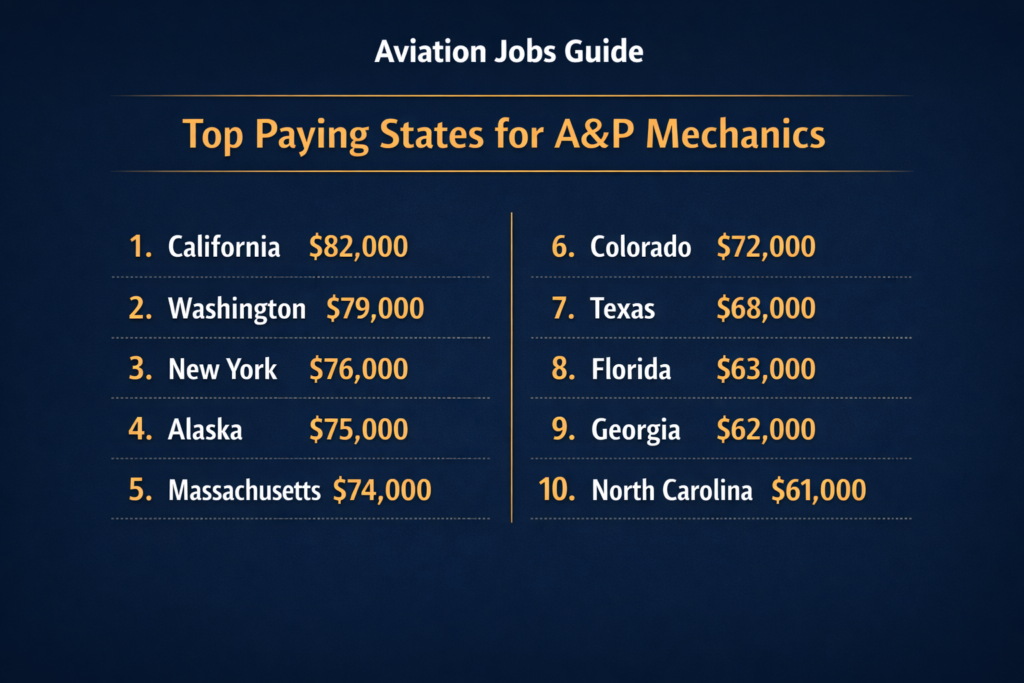
Where you live and work plays a massive role in shaping your first paycheck. High-density aviation corridors and major logistical hubs naturally offer higher compensation to offset local costs of living. For instance, a technician starting their career in Alaska, California, or the New York metro area will secure an entry-level A&P salary that trends toward the top of the national average.
Beyond geography, the structure of your compensation package matters. Many major airlines and cargo operators utilize union contracts that establish explicit pay scales. While it is more difficult for a brand-new graduate to bypass the line and step immediately into a major airline role without prior experience, those who do can see a starting entry level a&p mechanic salary exceed $60,000 due to collective bargaining agreements that prioritize standardized base rates and robust shift differentials.
The Outlook for Long-Term Career Growth

Ultimately, your starting salary is just a launchpad. The current aviation landscape is defined by an aging workforce, meaning senior inspectors and lead mechanics are retiring faster than the industry can replace them. This demographic shift guarantees that a dedicated mechanic who starts today will have clear, accelerated access to promotions, management roles, and specialized fields like avionics troubleshooting or quality assurance.
Securing your airframe and powerplant ratings unlocks a highly stable, technical career path where your skills are in demand worldwide. While your initial entry-level A&P salary is simply the beginning of your financial journey, the structural demand for safety ensures that your earning potential will continue to climb as high as your dedication takes you.
Other Articles You Might Enjoy!
Find Your First A&P Mechanic Job at Aviation Employment Network!
A&P Mechanic Salary: The Complete 2026 Guide to Aircraft Mechanic Pay
Barriers to Entry for an A&P Mechanic Career
Career Path of an A&P Mechanic: 5 Critical Things That Employers Need to Understand
How to Choose the Right Aviation Career: A Practical Framework for Making the Right Decision
Tool Control & FOD Prevention: 10 Proven Strategies for Safer, Stronger Maintenance Teams
High-Paying Avionics Technician Jobs
5 Inspiring Reasons to Consider Maintenance Jobs as a Career Choice
A&P MECHANICS CAREER GUIDE: 20 Reasons to Choose This Amazing Career Path
Career Aircraft Mechanic Salary to Compare With
10What is the average entry‑level A&P mechanic salary
9What factors affect entry‑level A&P pay
8Do entry‑level A&P mechanics get overtime
7Which states pay the highest starting A&P salaries
6Do airlines pay more than MROs for entry‑level A&Ps
5How much do A&P apprentices or trainees earn
4Does having both A&P certificates increase starting pay
3Do entry‑level A&P mechanics receive sign‑on bonuses
2How fast can an entry‑level A&P increase their salary
1What career paths lead to higher A&P earnings
Have any thoughts?
Share your reaction or leave a quick response — we’d love to hear what you think!
-
 0
0
-
0
-
0
-
0
-
0
-
0