AVIATION JOBS GUIDE
Annie’s Dream Takes Shape
The next chapter began, as many consequential American chapters do, with a spreadsheet. (Read Part 1 first.)
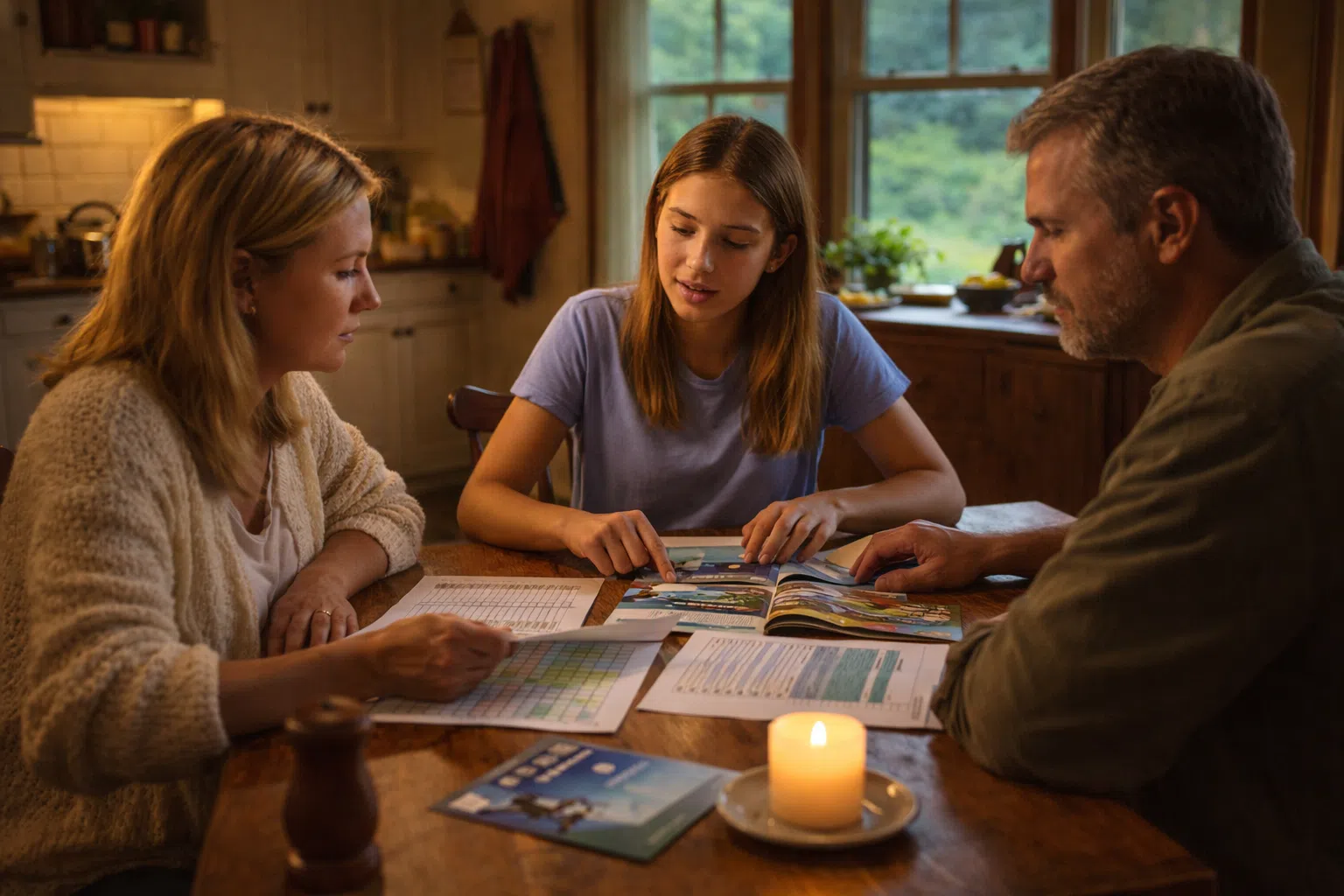
Not literally at first. At first it began with coffee, legal pads, and the mildly ceremonial seriousness that overtakes a family when it decides to stop discussing a future in the abstract and begin measuring it in dollars. By Saturday morning, Anne’s mother had cleared the dining-room table and placed on it a yellow notepad, two pens that worked, a laptop, and a determination that made the whole enterprise feel both more manageable and more frightening. Dreams, once translated into tuition tables and housing estimates, acquired a new grammar. They were no longer made of clouds and runway lights. They were made of line items.
Anne sat across from her parents in a sweatshirt, trying to appear calm in the presence of numbers that had the power to humble everyone in the room. Her father had the expression of a man preparing to negotiate with an invisible force. Her mother, already logged into the university website, had become brisk in the way she did when emotion threatened to interfere with logistics.
“Let’s start with facts,” she said.
This was her religion in difficult moments. Facts first. Feelings could wait their turn.
They had the admissions page open, then the degree page, then the cost-of-attendance page, which possessed the oddly antiseptic cheerfulness common to universities presenting alarming sums of money. Tuition was there. Fees were there. Housing and meal plans were there. Then came the aviation-specific expenses, which seemed to stand outside the normal economy like weather systems or acts of God. Flight lab costs. Training fees. Materials. The phrases were tidy. The effect was not.
Anne watched her father lean toward the screen. “That’s separate from tuition?”
“It looks like it,” Anne said.
“It always looks like it,” her mother said.
The school, which had seemed so elegant and inevitable when described in brochures and student videos, now revealed itself in its full institutional complexity. There was the academic side of becoming a professional aeronautics student, and then there was the flying side, which had its own cadence, expenses, benchmarks, and risks. It was one thing to tell your parents that you wanted to become a pilot. It was another to discover the exact cost of learning how.
They called the university on Monday.

Anne had expected something grander from such an important conversation, perhaps a conference call heavy with life-changing authority. What they got instead was a perfectly pleasant woman in an office who spoke with the calm efficiency of someone for whom other people’s futures arrived in fifteen-minute appointments. Her voice had the gentle, practiced clarity of a person accustomed to parental concern.
She walked them through the broad architecture first: the degree requirements, the distinction between academic tuition and flight training expenses, the timeline students generally followed, the ways in which progress depended not only on discipline but on weather, scheduling, aircraft availability, instructor assignments, and the student’s own performance. Aviation, in this telling, sounded less like a dream and more like a campaign.
Anne found that oddly reassuring.
There were options, the woman explained. Federal aid, if eligible. Scholarships, though competitive. Payment plans. Loans. Some students arrived with family support; some worked part-time where possible; some combined grants, borrowing, and private sacrifice in elaborate and not always graceful ways. Housing had its own decisions. Residence halls were available, particularly valuable for first-year students adjusting to both university life and the unusual demands of flight training. There were meal plans, shared rooms, and the possibility, later, of moving off campus if finances and maturity aligned. On-campus living, the woman suggested, often helped students remain close to the rhythm of the program.
That word—rhythm—lodged in Anne’s mind.
The woman then described the curriculum with a matter-of-fact seriousness that gave it moral weight. Ground school and aeronautical academics. Private pilot training. Instrument work. Commercial training. Multi-engine progression, depending on the track. Crew resource concepts. Systems. Weather. Regulations. Decision-making. The degree was not a scenic route to a cockpit. It was a layered construction project in which each level had to bear the weight of the next.
“There is a path,” the woman said, “but students do need to understand that it is demanding.”
Demanding. Such a polite university word. It covered a multitude of harsher truths.
After the call, the three of them remained at the table longer than necessary, as though each hoped the others might speak first and impose a useful interpretation on what they had heard. The mood in the room had changed. The dream had not dimmed, exactly, but it had acquired contour, resistance, and mass. It was no longer simply noble. It was expensive and administratively intricate and likely to ask more of Anne than she had ever been asked before.
Her father broke the silence first.
“Well,” he said, “they certainly don’t make it sound easy.”
“No,” Anne said.
Her mother closed the laptop halfway, not enough to end the conversation but enough to indicate that its digital portion had concluded. “Good,” she said.
Anne looked at her. “Good?”
“Yes. Good.” Her mother folded her hands. “If it were easy, I’d be more worried.”
This was the sort of sentence that could have sounded stern in another mouth. In hers it sounded like respect.
They began, then, to do the less romantic work that makes improbable journeys possible. What could they actually contribute? Not in the language families often prefer—vague expressions of support, emotional commitments, the warm but unusable assurance that they would somehow make it work—but in numbers. Anne’s parents were not secretly wealthy. There was no hidden fund waiting for the revelation of a sufficiently cinematic ambition. They had savings, obligations, habits of prudence, and the ordinary financial landscape of a family that had built its life carefully rather than spectacularly.
Her father said they could cover part of the first year if they were disciplined and shifted some priorities. Not all of it. But part. Her mother thought they could absorb housing more easily than flight fees, at least at the start, if they planned with rigor and accepted that certain comforts would retreat for a while. Vacations, such as they were, would become theoretical. Home projects would wait. Extra spending would be examined with the new suspicion that attaches to anything not directly serving a larger purpose.
Anne listened with a rising mixture of gratitude and guilt. There is a particular ache in being loved sacrificially. It is one thing to want a future. It is another to watch your parents rearrange their present to make room for it.
“I can work,” she said quickly. “I can work this summer. And during school, if it’s possible.”
Her mother nodded. “Yes. Some. But not so much that it hurts the reason you’re there.”
Her father, who had been making notes in a handwriting that always looked slightly surprised by itself, glanced up. “You’re going to have to treat this like a job before it becomes one.”
Anne let that settle in her. It had the ring of simple truth.
The spreadsheet came later, inevitably. Her mother built it with the severity of an engineer constructing a bridge that was expected to hold not only money but hope. Tuition. Fees. Flight costs. Housing. Meals. Books. Travel from Massachusetts to North Dakota and back again, which introduced the additional insult of geography into an already tender calculation. Then came columns for projected aid, savings, parental contribution, Anne’s expected earnings, and the remainder, that bleakly impersonal figure to be financed by loans or plans or the future version of Anne who would one day have to pay it back.
The remainder was not small.
No one pretended otherwise.
And yet there was, strangely, relief in the arithmetic. The number was formidable, but it was now a number, not a fog. It had edges. Families can face difficult numbers better than they can face shapeless dread.
In the days that followed, the story of Anne’s dream became less lyrical and more procedural, which is what happens when a life begins to move. There were emails. There were follow-up questions about residence halls, deposits, deadlines, and orientation. They learned that aviation students had to navigate two parallel educations: the official one listed in catalogs and the unofficial one learned by surviving the pace, pressure, and precision of the environment. Flying demanded consistency. College life tempted inconsistency. Weather could slow progress. Weak study habits could compound into delayed checkrides, repeated stages, added costs. A student might love airplanes and still discover, uncomfortably, that loving airplanes was not the same as mastering aerodynamics at midnight after a long day.
Anne read everything she could find about the program. Students talked about early mornings, winter wind, long preflights, frustration in the pattern, and the peculiar humiliation of working extremely hard at something that still refused to become easy. They also spoke of first solos, passed check-rides, friendships formed in shared fatigue, and the deepening confidence that comes only from competence honestly earned. It did not sound glamorous. It sounded meaningful.

One evening, after another round of calculations, her father sat back and rubbed his face with both hands. “This is a difficult path,” he said, not to discourage her but to name the thing correctly.
“Yes,” Anne said.
Her mother looked over at her. “Do you still want it?”
There are questions parents ask whose true subject is character. Anne understood that now. This was no longer a test of enthusiasm. It was a test of whether she could continue to choose the path after seeing the cost.
She thought of the little airport in Lenox. Of the fence. Of the training airplanes in summer light. Of the strange quiet certainty she had carried for years. She thought, too, of North Dakota, which she still knew mostly as an idea—cold, broad, exacting. She thought of debt, of distance, of hard work, of the likelihood that parts of the future would be lonelier and less cinematic than the dream had once suggested. She thought of the curriculum laid out before her like a mountain range with names she was only beginning to learn.
“I do,” she said. “I think I want it even more now.”
Her father gave a small nod, the kind men give when they have accepted that caution has done all it can do and must now make way for courage. Her mother closed the notebook.
Then, with no speeches and no grand family tableau, they returned to the work. There were forms to complete, figures to verify, timelines to build. The adventure, as it turned out, would not be launched on inspiration alone. It would be launched on discipline, borrowing, sacrifice, and the shared decision that a hard path was not the same thing as a wrong one.
That, Anne was beginning to learn, was one of adulthood’s sternest and most useful lessons. A worthy life did not present itself as easy. It presented itself as costly, then waited to see whether you would come anyway.